The 'Cobbler Count' and Other Oddities of Leo Tolstoy's Moscow Life
When we think of Leo Tolstoy, the image of the Yasnaya Polyana "hermit" in a simple peasant shirt comes to mind. Yet, almost twenty years of the great writer's life were spent in Moscow, in Khamovniki, and this period turned out to be perhaps the most dramatic and paradoxical in his biography.
Among Factories and the Insane Asylum
In 1882, Tolstoy buys an estate on the working-class outskirts of the city. Today, the Khamovniki district is considered elite, but back then the place was far from prestigious: on three sides the house was surrounded by a weaving factory, a perfumery, and a brewery. In modern terms, an ordinary industrial zone. Moreover, a psychiatric hospital was located nearby.
So why did he favor such a strange place? It is quite possible that the overgrown garden "bribed" the count, creating an illusion of silence, peace, and tranquility. They say when Tolstoy first came to see the house, it was already getting dark, which the owner pointed out. "No need to see the house. I see the garden," the writer snapped. And the garden was like a jungle: neglected, wild, with century-old trees on a whole hectare of land. This gave the writer the opportunity to feel almost like in Yasnaya Polyana, which he madly loved and always strived to return to.
Tolstoy personally supervised the remodeling of the house. He hired an architect but took on the duties of a foreman, delving into literally every detail. In letters to his wife Sophia Andreevna, he reported in detail on the progress of the work:
In general, the house is turning out very good. And the peace is a miracle. I don't even want to leave the wing—it's so quiet, nice, the trees are rustling...
He chose the wallpaper himself, bought furniture, decided what to paint where. As a result, the house became somewhat unusual: old low mezzanines coexisted with new high rooms for receiving guests.
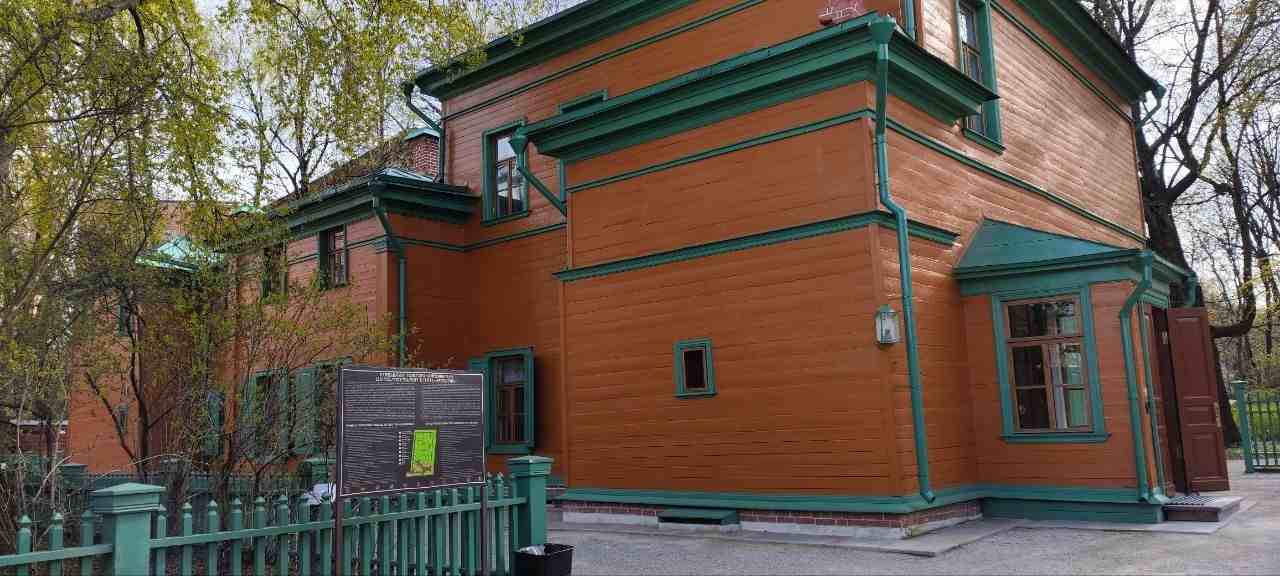 The writer's house in Khamovniki. Photo by the author. 2026.
Without Amenities and with the Smell of Valerian
Sometimes it's hard to believe that such a noble family lived in Moscow in far from the most comfortable conditions. There was no electricity in the house, so they had to use kerosene lamps and candles. There was no running water or sewage, so washstands stood in every room, and the family went to the bathhouse to wash. Every morning Tolstoy carted water from a well in the garden: in winter—on a sled, in summer—on a cart.
One of his daughters—the closest to Leo Nikolaevich—Maria Lvovna, was very passionate about medical work. Her room always smelled of medicines, herbs, and iodoform, which greatly irritated Sophia Andreevna. The girl selflessly helped in hospitals, treated peasants, but could not help herself. She died of pneumonia at the age of only 35.
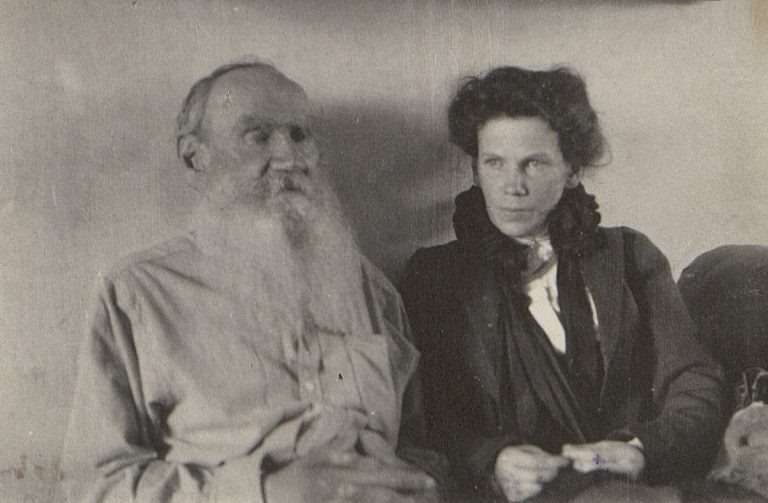 Leo Tolstoy and his daughter Maria. State Museum of Tolstoy
Craft as Philosophy
The most unexpected detail of the Khamovniki lifestyle is the shoemaker's workshop. At 55, Tolstoy decided to master a new craft. In a small room with a low ceiling, he set up his workspace. His son Ilya Lvovich recalled:
I don't know where he found a cobbler... bought tools, materials... set up a workbench... Hunched over the workbench, he carefully prepared the end, waxed the thread, broke it, started over, grunted from the strain, and, like an apprentice, rejoiced at every success.
Tolstoy made boots for himself and his friends. After sewing ankle boots for Afanasy Fet, he received a joking document from him:
As proof of the complete expediency of the work, I began to wear these boots the next day.
And his future son-in-law M.S. Sukhotin put the pair sewn for him on a bookshelf next to the twelve-volume collected works of the writer, attaching a label "Volume XIII". Leo Nikolaevich just chuckled into his beard: "My best work!".
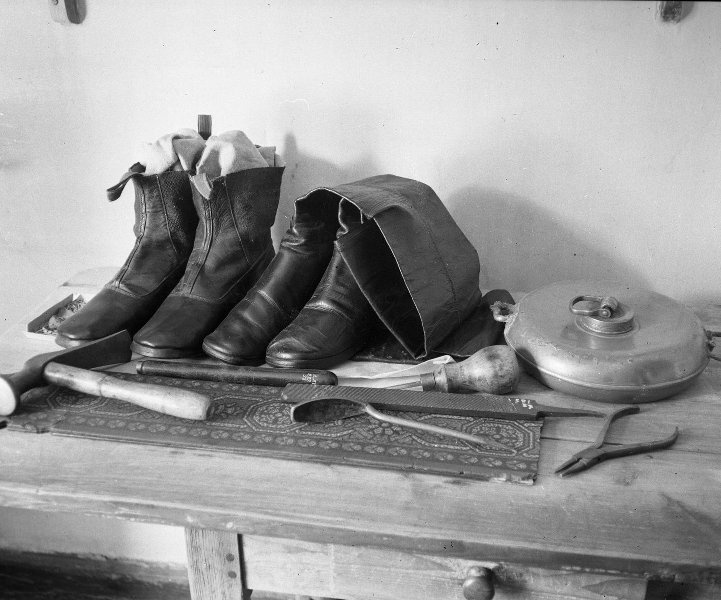 Left - A. Fet's ankle boots, right - M. Sukhotin's boots. Photo from the 1960s.
A New Sport at 67
Tolstoy was physically strong. He walked a lot, rode horseback, did exercises with dumbbells, chopped wood, sometimes harnessed himself to a cart instead of a horse, for example, to bring water from the well into the house. At 67, he mastered the bicycle, which was gifted to him by the Moscow Society of Bicycle Lovers. He quickly became addicted to cycling and even received a personalized ticket giving him the right to ride around the city. A white-bearded old man in a peasant shirt on a bicycle looked so unusual that passersby stopped and stared after him. In general, the count had many such "quirks"...
In winter, a skating rink was flooded in the garden, and Lev Nikolaevich skated with the children. He considered physical activity and sports the most important part of life. No less important than mental labor, crafts, and communication with people.
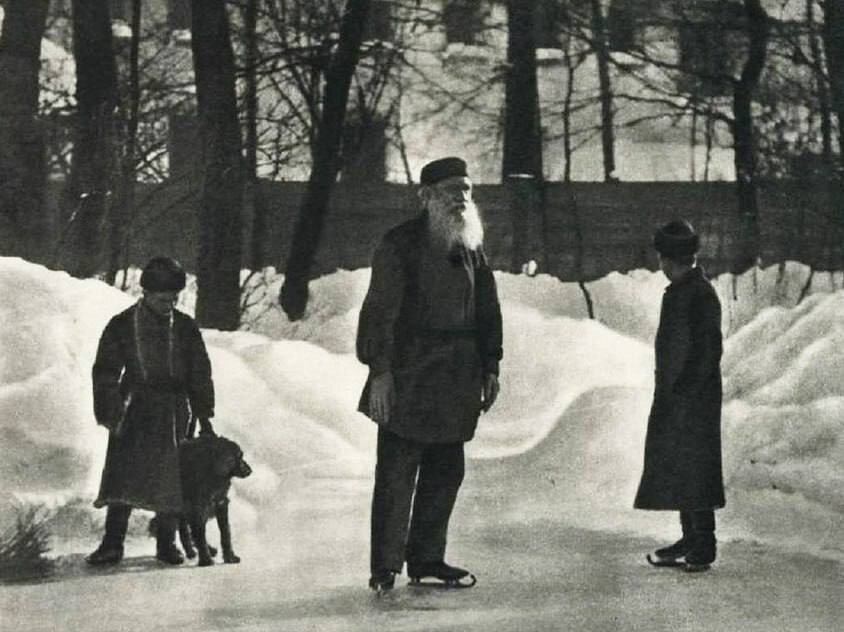 Tolstoy ice skating in his garden in 1898. Photo by Sophia Tolstoy.
Eternal Guests
Tolstoy's house was a true cultural center of Moscow, and the door to it was never closed. The writer read aloud to his family and guests both his own works and the works of other authors. He played the piano beautifully, composed waltzes, but most of all he loved folk and Gypsy songs. The writer's son Sergei Lvovich recalled:
I have never met anyone in my life who felt music as strongly as my father. Hearing music... he would get excited, something would tighten in his throat, he would sob and shed tears.
All the high society of Moscow gathered here: artists and writers—Anton Chekhov, Maxim Gorky, Alexander Ostrovsky, Ivan Bunin, Afanasy Fet, Vladimir Korolenko, Nikolai Leskov, Vsevolod Garshin, Ilya Repin, Valentin Serov, Nikolai Ge, Konstantin Korovin, Ivan Kramskoi. Musicians and composers were also frequent guests, among them Sergei Rachmaninoff, Alexander Scriabin, Nikolai Rimsky-Korsakov, Fyodor Chaliapin... At the same time, many so-called "dark" people—simple common folk—came to Tolstoy, entering through the "back door" and climbing up to the study via the back stairs. Leo Nikolaevich tirelessly repeated: if they come, it means they are needed by the people.
Family Drama
Behind this seemingly prosperous picture lay a deep family drama. In Khamovniki, Tolstoy went through a spiritual crisis that led to numerous conflicts and, ultimately, a break with his family. He renounced the copyright to his works of recent years, which deprived the family of income, called for "simplification", and was burdened by his property. The death of his youngest son Vanechka in 1895 was a severe shock for him: the seven-year-old boy, whom everyone adored, died of scarlet fever a month before his birthday. Tolstoy said then: "For the first time in my life I feel hopelessness."
I cannot help but feel the most sincere sympathy for all those moral rules that Levochka has set for himself and others. But I do not see and cannot find an opportunity to put them into life,
— wrote his wife Sophia Andreevna, who never forgot her maternal duty and responsibility to the family for a second.
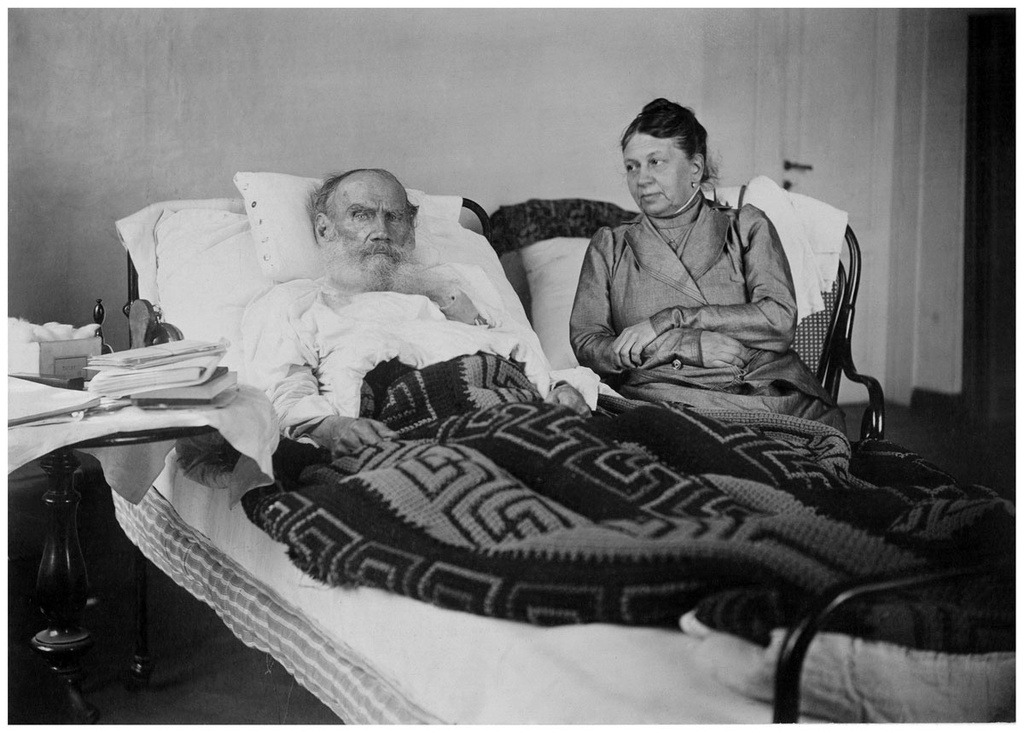 Sophia Andreevna at the bedside of her sick husband. 1902. State Museum of Tolstoy.
Farewell
Tolstoy lived in Khamovniki for 19 winters, from 1882 to 1901, where he wrote about a hundred works, including "Resurrection", "The Death of Ivan Ilyich", and "The Kreutzer Sonata". For the summer, the family always went to Yasnaya Polyana.
On May 8, 1901, Tolstoy left his Moscow house forever. He would visit here for the last time only in September 1909—a year before his death—while passing through to a friend's estate. A huge crowd gathered at the Kursky railway station, from which he was leaving. Tolstoy approached the carriage window to say goodbye, but tears interrupted his speech...
An Ordinary Miracle: How the House Survived
Amazingly, the estate in Khamovniki has survived almost in its original form. The secret lies in the foresight of Sophia Andreevna Tolstaya. Before selling the estate to the city authorities, she took on another colossal task—to compile a detailed inventory of 6,000 items, recording all the property and furnishings of the house. Thanks to this and the memories of the children, it was possible to restore the appearance of each room in detail. The museum opened in 1921 by personal decree of Vladimir Lenin and still remains one of the most atmospheric museums in Moscow—a place where you can touch history, see things touched by the hands of a genius, and feel the full drama of the great writer's family life.
I invite you to visit this extraordinary house with me.
© 2026 Ivetta Krasnogorskaya. All rights reserved.
Exclusive rights to this material (text and photographs) belong to the author. Any use of materials is permitted only with the written consent of the copyright holder. Full or partial copying, rewriting, distribution, and publication on the Internet without permission is prohibited.
When quoting, an active indexed link to the original source is required: mosivetta.ru/en/blog/Tolstoy-Hamovniki