Berlin — Moscow: What the Butterfly Slab Keeps Silent About 🦋
In the center of Moscow, in the quiet courtyard of the former Usachev-Naidyonov estate on Zemlyanoy Val, stands a strange, at first glance, art object: a gray concrete slab decorated with metal butterflies. Some passersby don't even notice it. Meanwhile, it is a genuine fragment of the Berlin Wall, destroyed in 1989. One of such pieces was given to Moscow as a reminder of the past by the legendary Berlin Museum "Checkpoint Charlie".
I visited the Berlin Wall and the museum back in the distant year of 2018. However, the emotions still don't let me go — more on that below.
💋 A Kiss Impossible to Forget
No matter how you decorate a concrete slab—with butterflies or flowers—it remains a cold piece of stone, a kind of tombstone of history. The feelings are mixed when you know the context.
Those who have been to Berlin and seen the Wall on a larger scale will surely remember this famous graffiti called "The Fraternal Kiss" with the inscription:
"God! Help me to survive this deadly love."
This kiss of the Soviet leader Leonid Brezhnev and the GDR leader Erich Honecker was first captured by the French photographer Régis Bossu during the celebration of the 30th anniversary of the GDR. And the artist Dmitry Vrubel "transferred" the photo onto the wall, enlarging it and making it color — it was in 1990.
In 2009, when the wall was being restored, the image was painted over. But Vrubel did not give up and repeated it.
Few people know that the author of this work is a relative of the famous artist. Dmitry Vrubel considered Mikhail Alexandrovich his namesake for a long time, until his father revealed the truth: Dmitry's paternal grandfather was the great-grandnephew of the great painter. Dmitry Vrubel passed away in August 2022 — he died in Berlin at the age of 62.
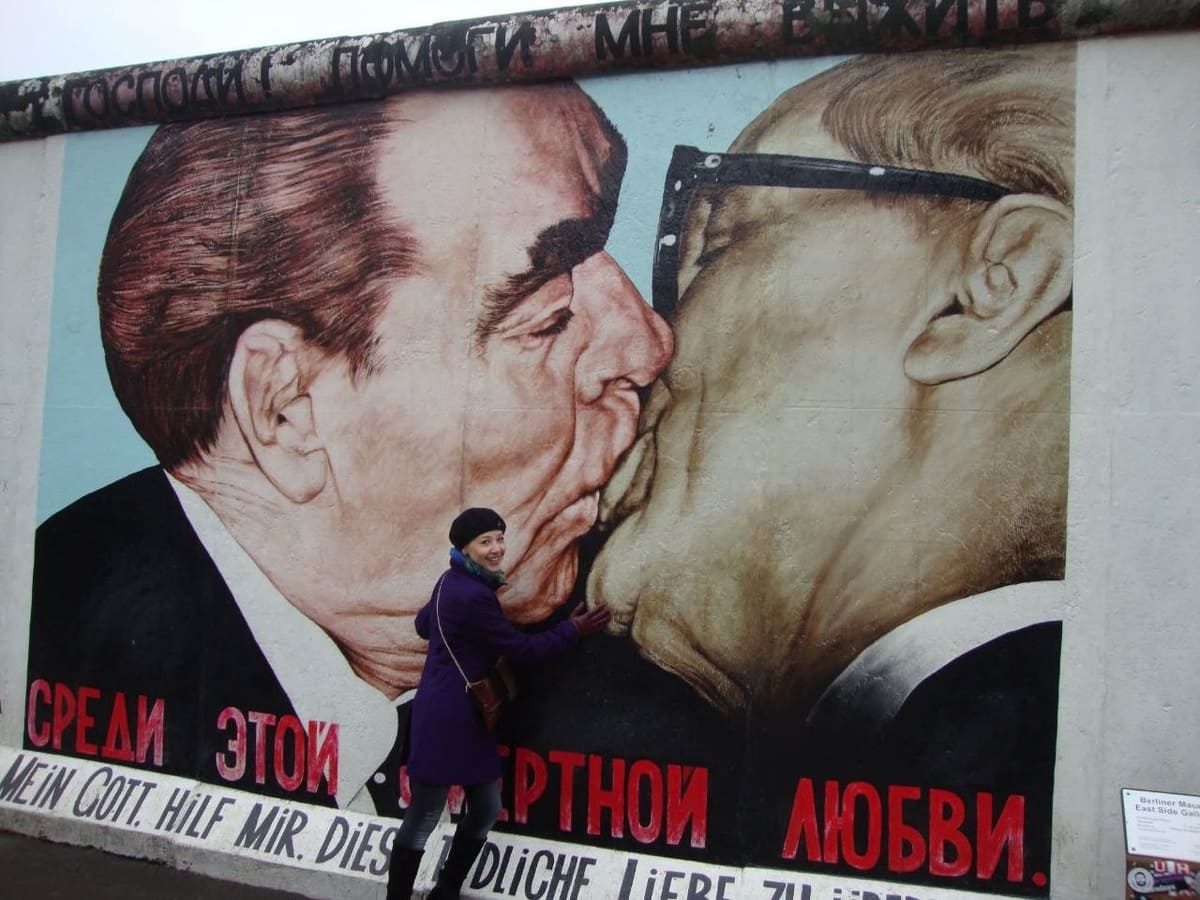 The most famous fragment of the Berlin Wall and me in March 2018. Photo from the author's personal archive
🚗 Escapes in Suitcases, in Cars, and on a Balloon
Now about the "Checkpoint Charlie" museum, which amazed me to the core. It is located at Friedrichstrasse, 43, literally a few dozen meters from the place where the border between the American and Soviet sectors of Berlin once ran. The very name "Checkpoint Charlie" is the Allied code designation: "Alpha" was in Helmstedt, "Bravo" in Dreilinden, and "Charlie" — here, at Friedrichstrasse.
It was then that I truly understood for the first time what the Berlin Wall was and what a country divided into two halves meant. This is when your loved ones are there, and you are here, and you need to choose: risk your life or come to terms with it. And people chose to take the risk.
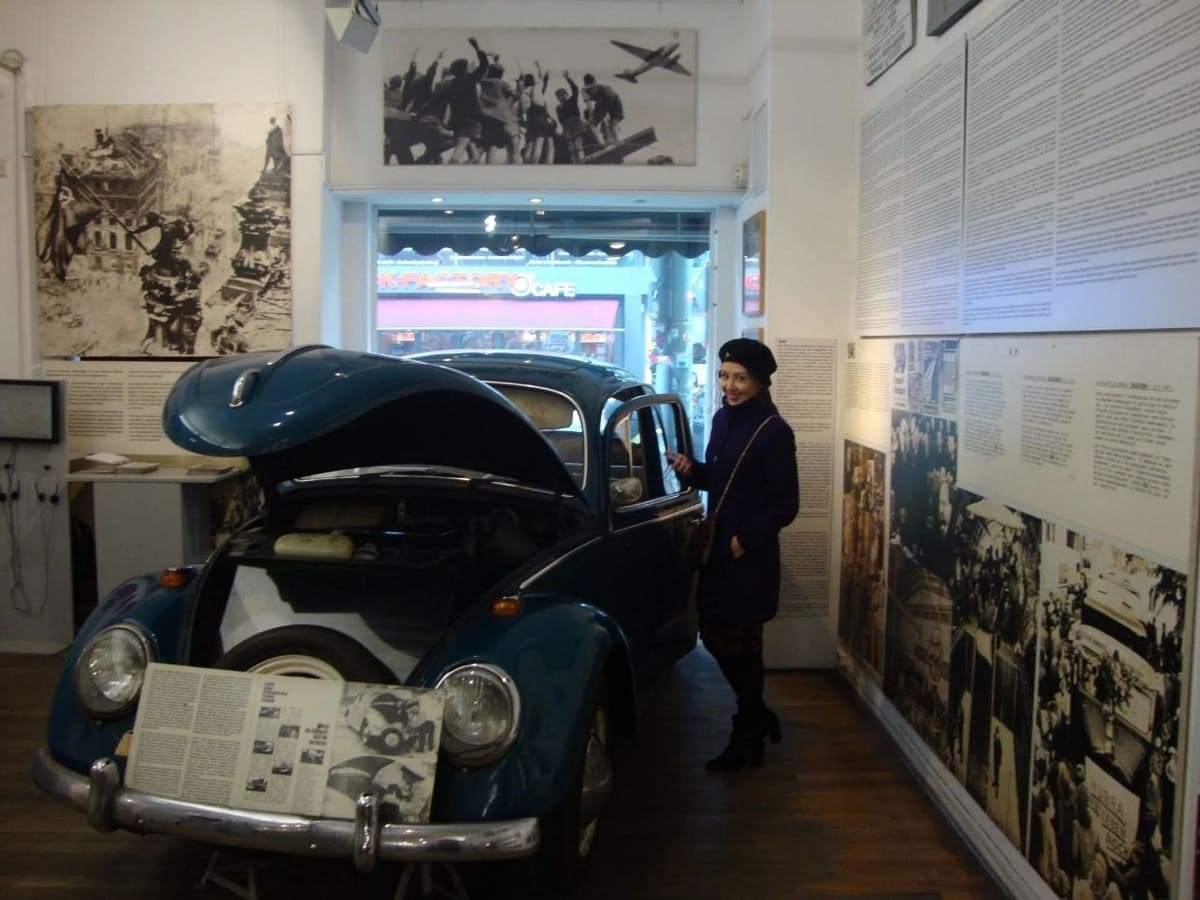 Me at the Checkpoint Charlie museum. 2018. Photo from the author's personal archive.
The museum shows hundreds of ways in which East Germans tried to get to the FRG. And each one is like a thriller script.
One of the most terrifying episodes I remember is the Jaeger family. In 1973, they smuggled their children out in suitcases through the checkpoint. First the older ones, then, the next day, the mother with the baby. And it worked. How much nervous strain it cost — it's scary to even imagine.
Another method of illegal crossing is hiding places in cars. Here is a red Ford Mustang with a compartment the size of a box: a person could lie there only heavily curled up. And here is a tiny BMW Isetta, in which everything unnecessary was dismantled to squeeze in an escapee. And there was also a mini-submarine and a huge homemade balloon on which entire families flew over the wall under the muzzles of machine guns.
And yet every fifth escape ended in death. A young guy, Peter Fechter, was shot on the neutral strip in 1962. He bled for about an hour, and no one — from either side — dared to approach him.
⚠️ The Poster as a Harbinger...
Pay attention to the photo below. I simply photographed the facade of the museum, but did not attach much importance to this banner in the form of the Ukrainian flag on the German building with an inscription in English and Russian. I am a specialist in intercultural communication, a guide-interpreter showing foreigners the beauty of our city, an "experienced" traveler far from politics...
At that time, I did not fully realize the approaching disaster, did not understand that in a few years we would live in a completely different reality.
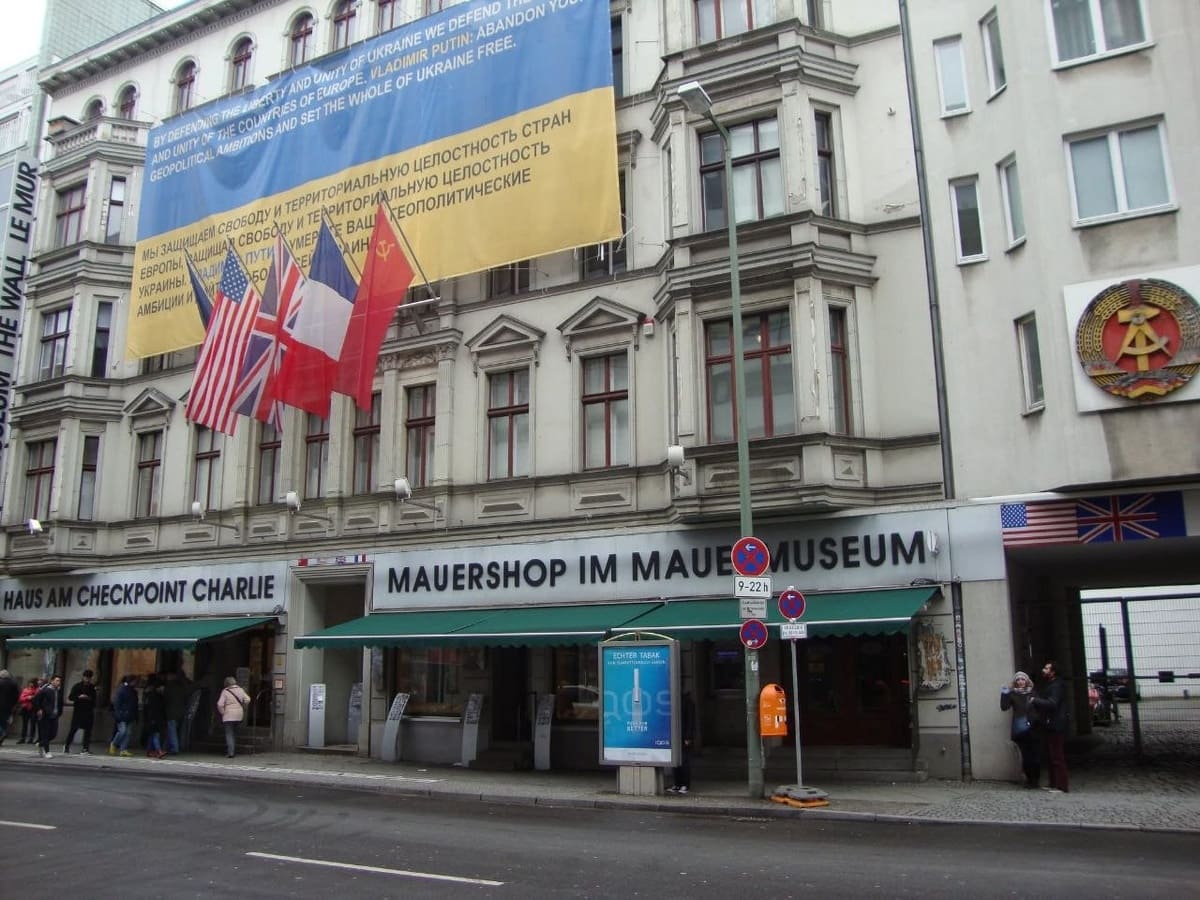 The museum entrance and the banner in 2018. Photo from the author's personal archive
🕊️ Instead of an Afterword
This piece of the Berlin Wall in Moscow is a silent reminder of how fragile peace is, how easy it is to divide and turn people against each other, to cripple families and destinies.
I thought: let it be a photo for memory. No one knows how long it will still stand in this courtyard…
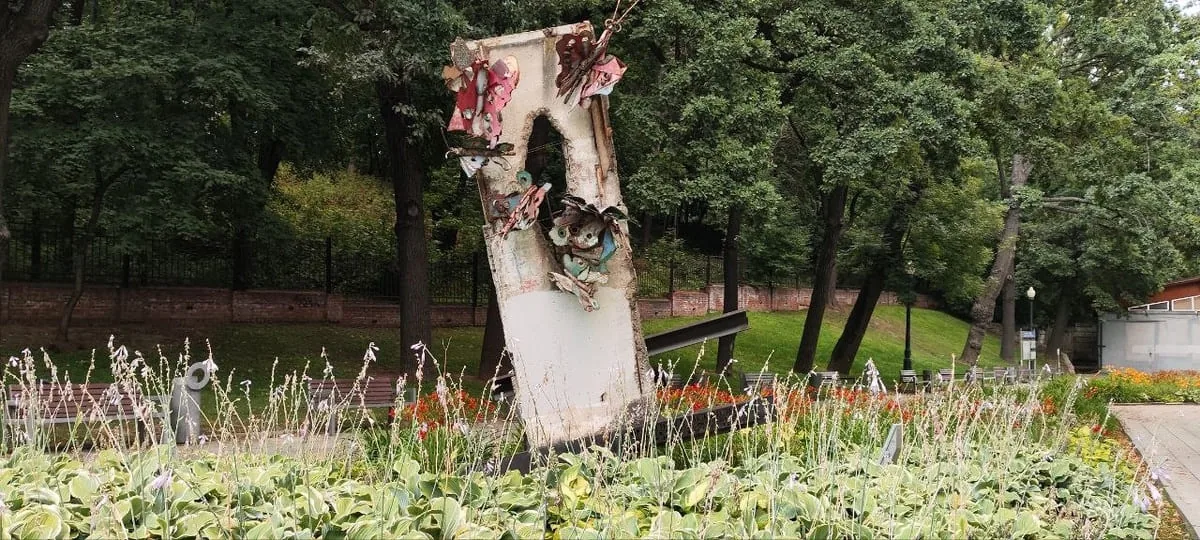 The butterfly slab in the Moscow courtyard
© 2026 Ivetta Krasnogorskaya. All rights reserved.
Exclusive rights to this material (text and photographs) belong to the author. Any use of materials is permitted only with the written consent of the copyright holder. Full or partial copying, rewriting, distribution, and publication on the Internet without permission is prohibited.
When quoting, an active indexed link to the original source is required: mosivetta.ru/en/blog/berlin-wall-butterflies