The Museum of the Dog in Moscow: Stories of Devotion
Did you know that Moscow has a Museum of the Dog? What's more, the museum claims to be the only one of its kind in Russia. It is small and somewhat cramped, and the exhibits consist more of photographs than of artefacts. But the guide will tell you so many interesting and touching things about our four-legged friends that even someone who is indifferent to animals will start looking at them differently.
Bribes in Borzoi Puppies
Remember the hero of Gogol's "The Government Inspector", who took bribes in borzoi puppies? This was no accident: in the 19th century a Russian borzoi cost a fortune — a single puppy could be traded for a village with its serfs. Their speed of 60–80 km/h made them ideal hunting dogs and a symbol of prestige.
And why are spaniels' ears so long and pressed to the head? Most likely so that water would not get inside when the dog dives after game. Poodles, by the way, are also "waterfowl hunters" — we have just "retrained" them into decorative dogs. And a dog's birth certificate — an actual state document — have you ever seen one? I was surprised...
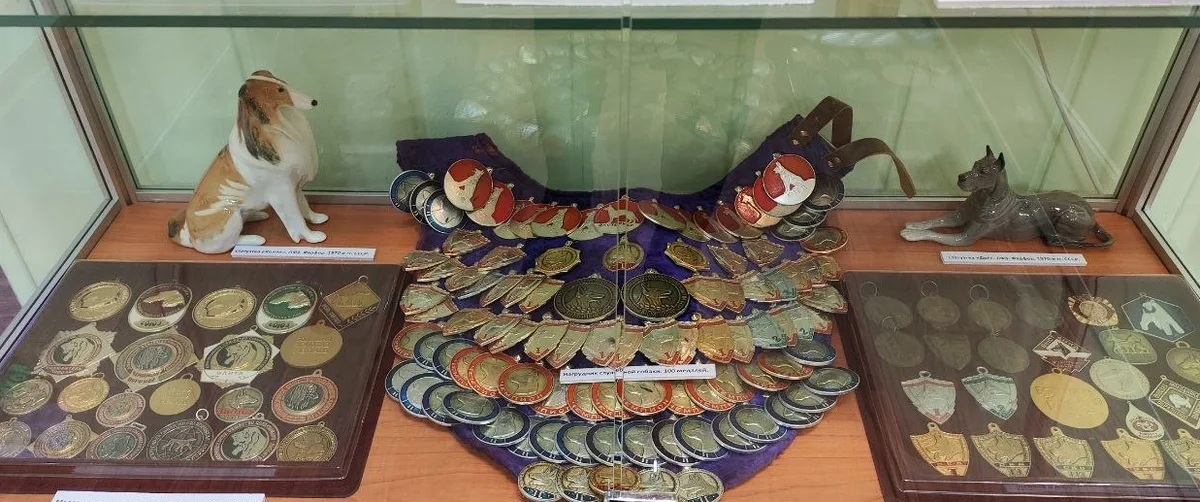 Medals of service dogs. On the chest plate in the centre of the display case are 100 medals belonging to one such heroine.
A Russian Hachiko
The Hall of Arctic Exploration shatters stereotypes. Particularly striking is the story of the polar explorer Georgy Sedov's expedition: poorly equipped, with poor-quality food and unprepared dogs collected from the city streets, it ended tragically. But Sedov's faithful dog Fram showed true heroism. They say he stayed at his master's grave in the Arctic wasteland, choosing a faithful death over returning to people. How it really was is not known for certain — but there is no doubting the devotion of our four-legged friends.
Fighters of the Invisible Front
The central part of the museum is dedicated to the Great Patriotic War. In the First World War, Russia sent only 300 trained dogs to the front; in the Second — already 68,000. Most of them were mongrel strays — but what dogs they were!
Sanitary dogs saved more than 600,000 wounded. They learned to tell the dead from the living even when the living were unconscious, licking and nudging the soldiers to bring them round.
Tank destroyers were dogs with belts packed with explosives: they crawled under German tanks and destroyed them.
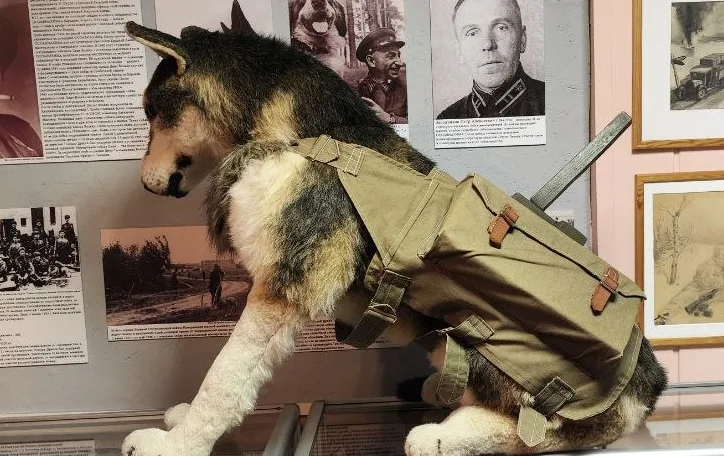 Dogs with this equipment destroyed tanks.
Many served in chemical reconnaissance — the most secret service of all. Dogs in gas masks and special suits entered contaminated zones.
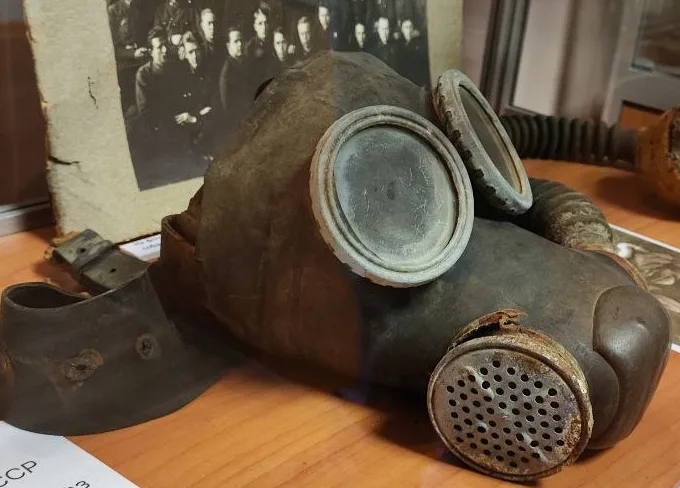 This is what a dog gas mask looks like.
Heroes of Leningrad: a collie named Dick found a 2.5-ton landmine in the foundations of the Pavlovsk Palace an hour before it was due to detonate, saving the architectural heritage. And Dina became the world's first dog-saboteur, blowing up an enemy train.
288 combat dogs marched in the Victory Parade. Only eight of their names are known — the rest remained anonymous, ready to give their health and their lives for victory.
Tails in Space
48 dogs have been to space, but we mostly remember only Belka and Strelka. Yet there were suborbital flights too! Dezik and Tsygan were the first to be sent into the unknown, in 1951, and the record holder for the number of flights was Otvazhnaya (affectionately called Kusachka, "the Snappy One") — five successful launches.
Of course we also remember Laika, who died. Belka and Strelka became heroes because they were the first to return alive from Earth orbit. But here is a photo of the less famous Veterok and Ugolyok, who flew around the Earth for as long as 22 days. The price of the experiment was high: after the long stay in zero gravity the dogs' muscles atrophied, and Veterok lost his teeth. He lived at the Institute of Space Medicine to a ripe old age, where the staff respectfully called him "the Director": in search of soft food, he would walk into any office "without knocking".
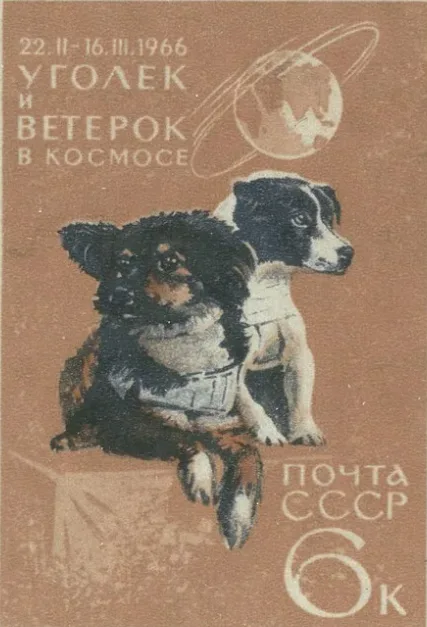 Veterok and Ugolyok on a Soviet stamp.
Once again you become convinced: "a dog is man's best friend" is not just words. Sometimes a dog is capable of what not every one of us would dare: to follow its master to the ends of the earth, to die to save others, and to silently endure the pain of experiments for the future of science. If you love animals — this museum is worth a visit.
Thank you for reading. Come to my tours — I'm glad to have you with me! You can also find me at mosivetta.ru and on Telegram in Russian and English.
© 2026 Ivetta Krasnogorskaya. All rights reserved.
Exclusive rights to this material (text and photographs) belong to the author. Any use of materials is permitted only with the written consent of the copyright holder. Full or partial copying, rewriting, distribution, and publication on the Internet without permission is prohibited.
When quoting, an active indexed link to the original source is required: mosivetta.ru/en/blog/dogs-museum