300 Years of Solitude, or the Odyssey of Peter the Great's Cabin
In Moscow's Kolomenskoye Museum-Reserve, surrounded by ancient oaks and golden church domes, stands a modest wooden house. Most visitors walk straight past it, never realising they're passing the only memorial museum in the capital dedicated to Peter the Great. And yet this little building has a backstory that reads like an adventure novel: floods, fires, a last-minute reprieve from demolition, and an extraordinary journey across Russia.
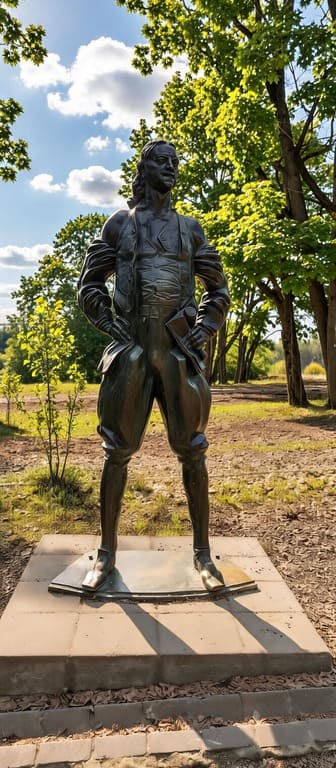
Monument to Peter the Great in Kolomenskoye
Born by the White Sea
In May 1702, Peter arrived in Arkhangelsk. The Swedes had the Baltic sewn up, so the White Sea was Russia's only trading gateway to Europe. The Tsar threw himself into building a fortress to defend the city – and had a small wooden house knocked together on a sandy island nearby for his own use.
It wasn't a palace by any stretch, but it had character. Russian carpenters and Dutch shipbuilders worked side by side, and the result was an odd but charming hybrid: a traditional Russian layout with rooms in a straight line, but fitted with oversized gallery windows and doors with curved tops that looked like they belonged on a ship. The glass was made using a technique called "moon glass" – each pane started as a giant bubble, then was flattened to leave a swirling crater-like pattern.
Peter lived here for about two months, running the defence of Arkhangelsk, monitoring shipbuilding, and celebrating his name day with typical gusto.
A House That Refused to Die
This little dwelling led a remarkably dramatic life:
- 1710: Spring ice floes wrecked its original spot. So they took it apart and moved it to higher ground by the fortress.
- 1761: A fire broke out – but the house survived, albeit a little more battered.
- 1877: The fortress was closed, and the house was shifted again, this time to the centre of Arkhangelsk, where it was given a protective casing.
- 1934: The Soviets ordered it demolished. Enter Pyotr Baranovsky – the museum's director, who had already saved St Basil's Cathedral from the wrecking ball. He fought to bring the house to Moscow, at his own expense. A tiny team of four spent two years dismantling it log by log, shipping it by train and boat, and piecing it back together in Kolomenskoye.
In 1936, it opened to the public – and it's been here ever since.
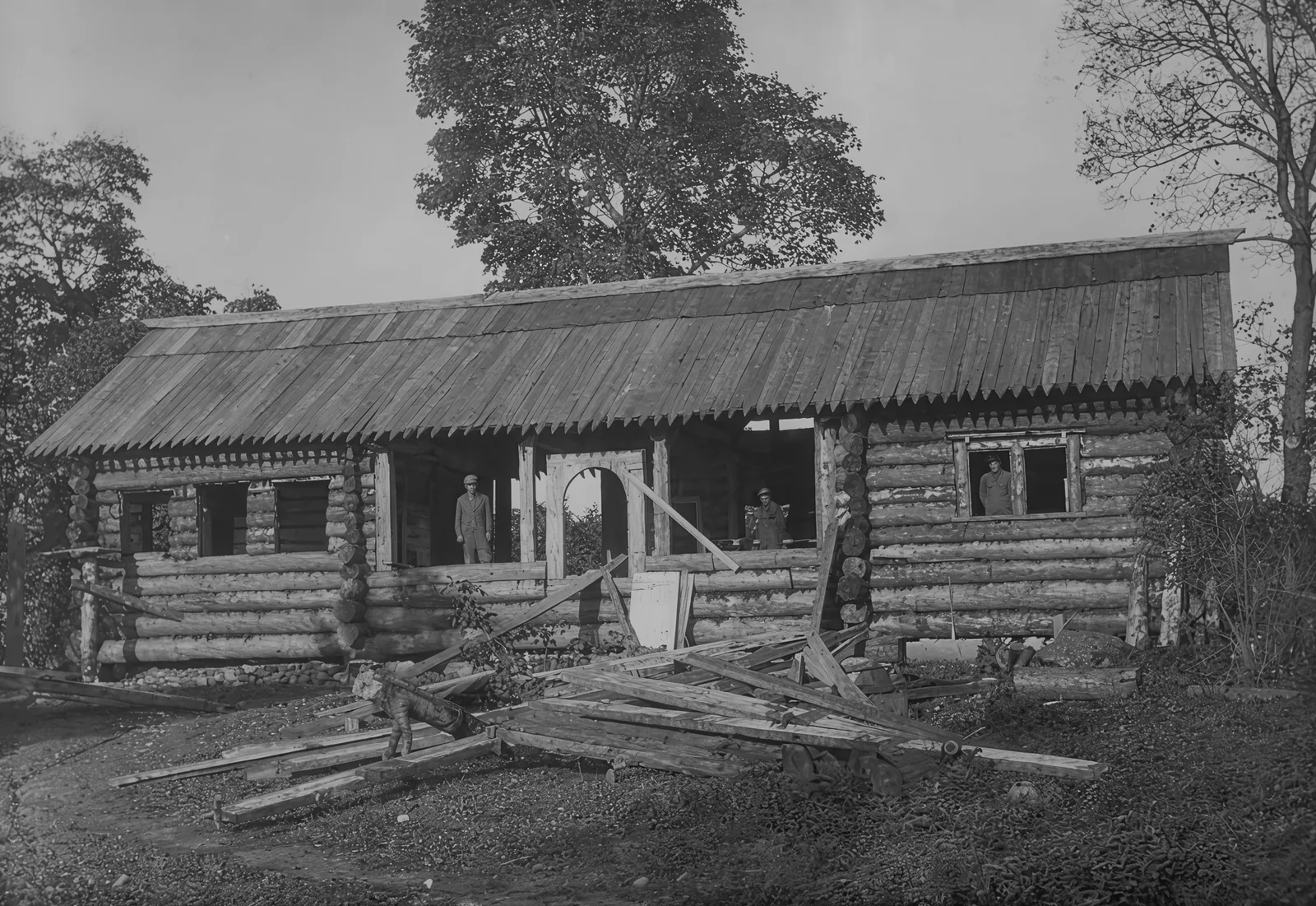
Reassembling the house in Kolomenskoye, 1934–1935
Inside the Tsar's Campaign Cabin
Today, the interiors recreate the feel of Peter's era. The rooms are modest but full of character: an entrance hall, a study, a dining room, a bedchamber, and a tiny room for his orderlies. Most of the furnishings are genuine period pieces – though from the 17th to 19th centuries, since very little of the original contents survived.
Here are some of the most intriguing details:
The Bedchamber
Peter slept half-sitting, propped up on stacks of pillows. The belief was that lying flat would let "bad blood" from the legs mix with the "good blood" in the head – and you might not wake up. Medieval logic, but even a reformer like Peter apparently took it seriously. Nearby hangs a washbasin with two spouts – he was famously clean and once refused to shake a man's hand because his fingernails were dirty. Also here: a tiny mirror. Large ones were always kept covered, lest the soul escape into the looking glass.
The Orderly's Room
Peter brought two orderlies to Arkhangelsk. One of them was Alexander Menshikov, his future right-hand man. The orderly's duties included guarding the Tsar's sleep – which meant sleeping on the floor, right beside Peter's bed.
The Study
This was a room that didn't exist in traditional Russian houses of the time – but Peter, being Peter, created one. Here he wrote letters in his famously chaotic handwriting: missing vowels, jumbled letters, and random foreign words thrown in. Historians still puzzle over it.
He also had unusual hobbies. One of them was dentistry – he learned it during his travels in Holland and returned with a diploma. Back home, he enthusiastically pulled teeth from his courtiers, even healthy ones, "just in case." Over sixty of his extracted teeth are still on display in St Petersburg's Kunstkamera.
The one craft he never mastered? Weaving bast shoes.
"There is no trade trickier than the shoemaker's," he once admitted.
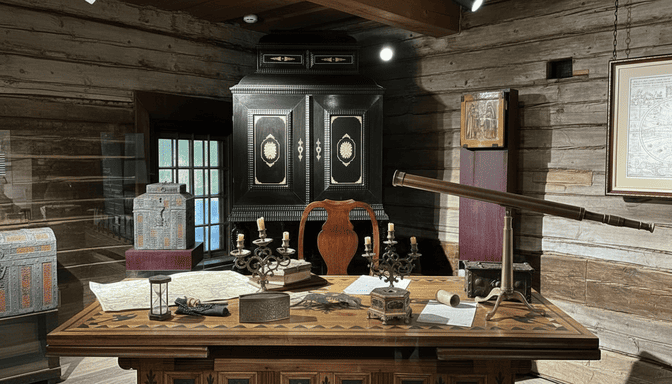
Peter's recreated study
The Dining Room
This is where Peter celebrated his name day in 1702. Tables were laid inside for the nobility – and outside for everyone else. Food was brought in from Moscow, and for three days after the feast, anyone could eat for free. The locals loved it so much they kept up the tradition every year until the Revolution.
Look closely at the tableware: pewter plates and lidded beer tankards. And no tablecloth – Peter ordered it removed because the boyars kept wiping their greasy hands on it.
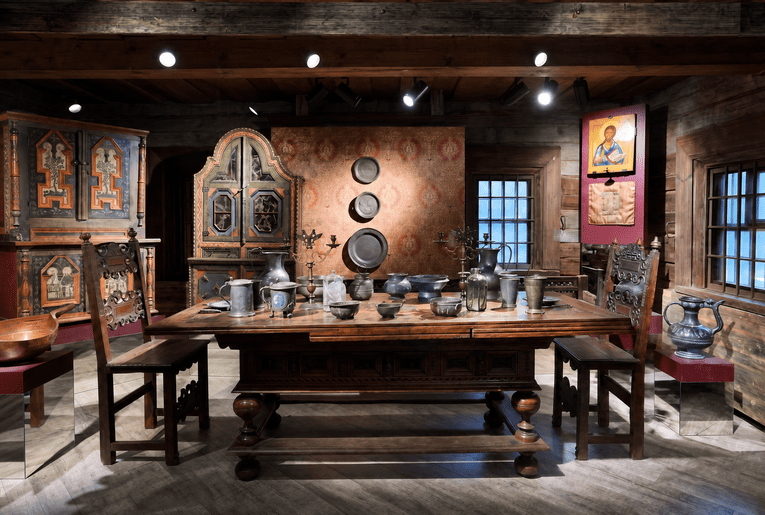
The dining room today – all items are authentic period pieces
Why Bother Visiting?
This little house isn't just a preserved cabin – it's the spot where Peter planned Russia's rise as a naval power. The recently refreshed exhibition brings all that to life in a way that feels personal, not dusty.
If you're in Kolomenskoye, don't just walk past. The tickets are cheap, and the stories are anything but. Or better yet – come on one of my guided tours, and I'll show you exactly why this unassuming wooden house is one of Moscow's hidden treasures.
© 2026 Ivetta Krasnogorskaya. All rights reserved.
Exclusive rights to this material (text and photographs) belong to the author. Any use of materials is permitted only with the written consent of the copyright holder. Full or partial copying, rewriting, distribution, and publication on the Internet without permission is prohibited.
When quoting, an active indexed link to the original source is required: mosivetta.ru/en/blog/peter-house-odyssey