The Pink of History: What Ostankino Has in Common with the Thigh of a Frightened Nymph
The Ostankino estate is going through a second birth today: a major restoration is in full swing, and for now only two pavilions are open to visitors — the Egyptian and the Italian. I can hardly wait for the whole estate to open its doors, but right now I want to talk about the first thing that catches your eye and unites these restored gems — the wonderful historic pink in which the estate's buildings are painted. Behind this delicate shade lies more than an architectural tradition: it's a whole story with French charm, poetic metaphors and the legendary name "the colour of the thigh of a frightened nymph".
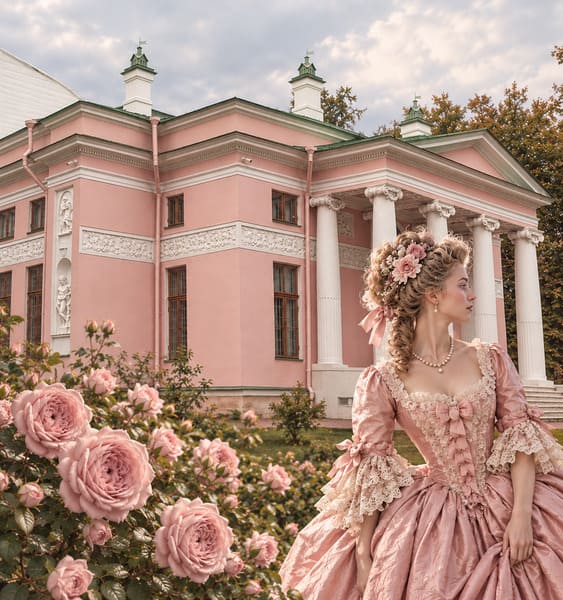 Ostankino in the colour of roses and French chic
Apollo's colour: why Ostankino is pink
The choice of pink for Ostankino was no accident. The palace, built for Count Nikolai Sheremetev in the 1790s, was conceived as a "Pantheon of the Arts" — a temple dedicated to Apollo, patron of the muses. According to classical tradition, the god of light and the arts deserves the colour of the morning dawn — a tender golden-pink. It was exactly this shade, which researchers call "Apollo's colour", that the palace facades were painted, with their snow-white columns and stucco details.
The tradition is alive today: after restoration, the facades once again shine in a light pink that, set against the white columns, sculpted reliefs and moulded frieze, gives the building lightness and airiness.
"The thigh of a frightened nymph": how the most playful colour name was born
Now let us travel from Ostankino to eighteenth-century France, to the age of rococo, which gave the world a fashion for elaborate, poetic and occasionally risqué names for colours. This is the era that produced the expression "the colour of the thigh of a frightened nymph" (cuisse de nymphe effrayée) — one of the most celebrated names in the genre.
The most convincing version of its origin is a story about roses. In 1802 the French breeder Jean-Pierre Vibert (other sources say Dumont de Courset) introduced a rose variety with petals of a delicate, faintly pink hue. The variety was given the poetic name "Thigh of a Frightened Nymph". The idea was that the skin of a nymph fleeing from a satyr blushes pink with fear. The rose itself was not new: it had been brought to France from Crimea as far back as the late sixteenth century, but it was in the early nineteenth century that it acquired its legendary name.
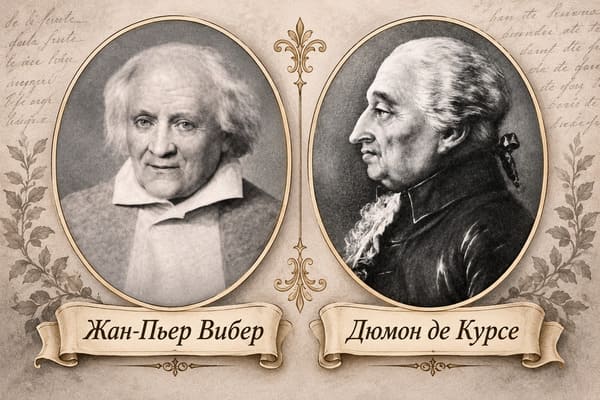 The French breeders mentioned in the text
From Kuragin's pantaloons to soldiers' uniforms
The expression entered the Russian language thanks to Leo Tolstoy's War and Peace. In one of the chapters Prince Hippolyte Kuragin appears at a reception in pantaloons of the colour cuisse de nymphe effrayée. Tolstoy used the phrase as a poetic licence, to emphasise the character's affected manner and limited mind. Scholars believe that in the period described — the early nineteenth century — no such established name existed yet in French.
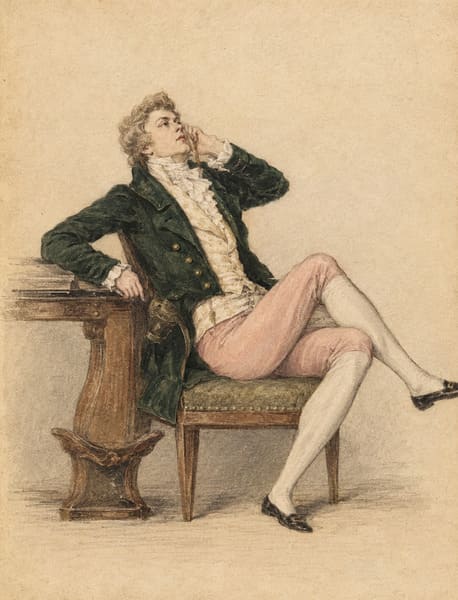 The author of this illustration to Tolstoy's novel is Mikhail Bashilov. We tried to colour the black-and-white drawing to imagine how Kuragin would have looked in the colour described
The name, however, took root in Russia — and in everyday life at that. Under Emperor Paul I, the lining of military uniforms was dyed this pink with a yellowish tinge. As the fabric used for officers and for soldiers was of different quality, the shades were perceived differently: the refined officers' shade was called "the colour of the thigh of a frightened nymph", while the coarser soldiers' version was jokingly nicknamed "the colour of the backside of a frightened Masha".
The pink thread that binds the epochs
Today, looking at the restored facades of Ostankino, we see that very "Apollo's colour" — a symbol of the morning dawn and of the patronage of the arts. And in the name "the thigh of a frightened nymph" lives the spirit of French rococo, with its love of play, metaphor and sensual beauty. These two shades of pink — one architectural, the other poetic — remind us how the cultures of different countries and epochs intertwine into a single history, in which architects, poets and fashion designers all speak the language of colour.
All that remains is to wait for the estate to open in full, so that we can see this pink symphony in all its glory.
© 2026 Ivetta Krasnogorskaya. All rights reserved.
Exclusive rights to this material (text and photographs) belong to the author. Any use of materials is permitted only with the written consent of the copyright holder. Full or partial copying, rewriting, distribution, and publication on the Internet without permission is prohibited.
When quoting, an active indexed link to the original source is required: mosivetta.ru/en/blog/pink-en