The Tower with Secrets: Savvinskoye Podvorye
Every Moscow local historian has their favorite buildings. For me, one of these is the Savvinskoye Podvorye revenue house, hidden behind a Stalinist building on Tverskaya Street (Building 6, Structure 6). This fairytale tower by architect Ivan Kuznetsov, built in the Neo-Russian style with elements of Baroque and Art Nouveau, has delighted our city since 1907. The only pity is that it undeservedly stands in the "backyards" of Moscow's central street—the result of the relocation of houses in the 1930s–1940s, which I, of course, talk about during my tour of Tverskaya.
Today, it especially pleases the eye because it looks "brand new". For many years it fell into disrepair without major repairs, until a large-scale restoration was finally carried out, during which details came to light that had remained outside the scope of excursion stories for so many years.
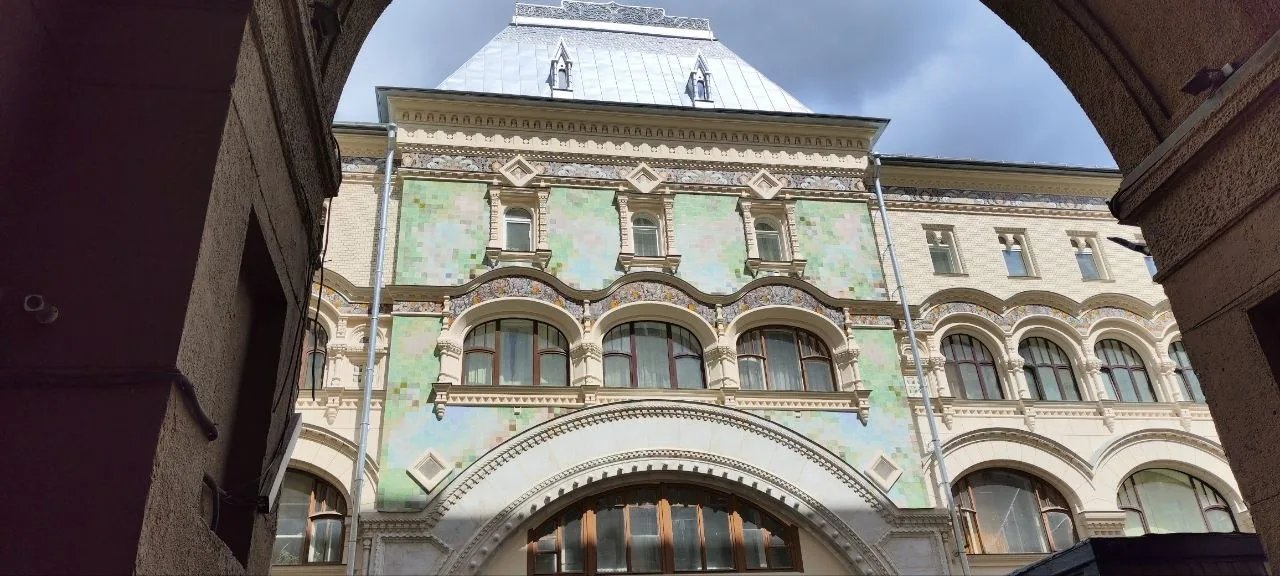 Savvinskoye Podvorye revenue house. Tverskaya, 6, bldg. 6.
Falconier Glass Bricks
One of the main surprises was the window openings laid with Falconier glass bricks. We are talking about handmade shaped hollow glass blocks, invented by Swiss architect Gustave Falconier in the late 19th century. They had unique properties: lightness, strength, moisture resistance, fire resistance, and at the same time they let in diffused daylight. These bricks were awarded prizes at the World Exhibitions in Chicago (1893) and Paris (1900). In Russia, Falconier glass blocks were produced by several factories: "M. Frank & Co" in St. Petersburg, Joseph Frederic Dutfoy in Butyrskaya Sloboda, "Gurevich Partnership" in Pskov Governorate, and the "N. and M." factory in Gus-Khrustalny.
In the Savvinskoye Podvorye, Falconier bricks were used for glazing the stairwell windows. In Soviet times, they were not restored—they were simply bricked up, painted over, or covered with plywood. During the restoration, the presence of the glass blocks was first identified using laser scanning, and then they were cleared and restored.
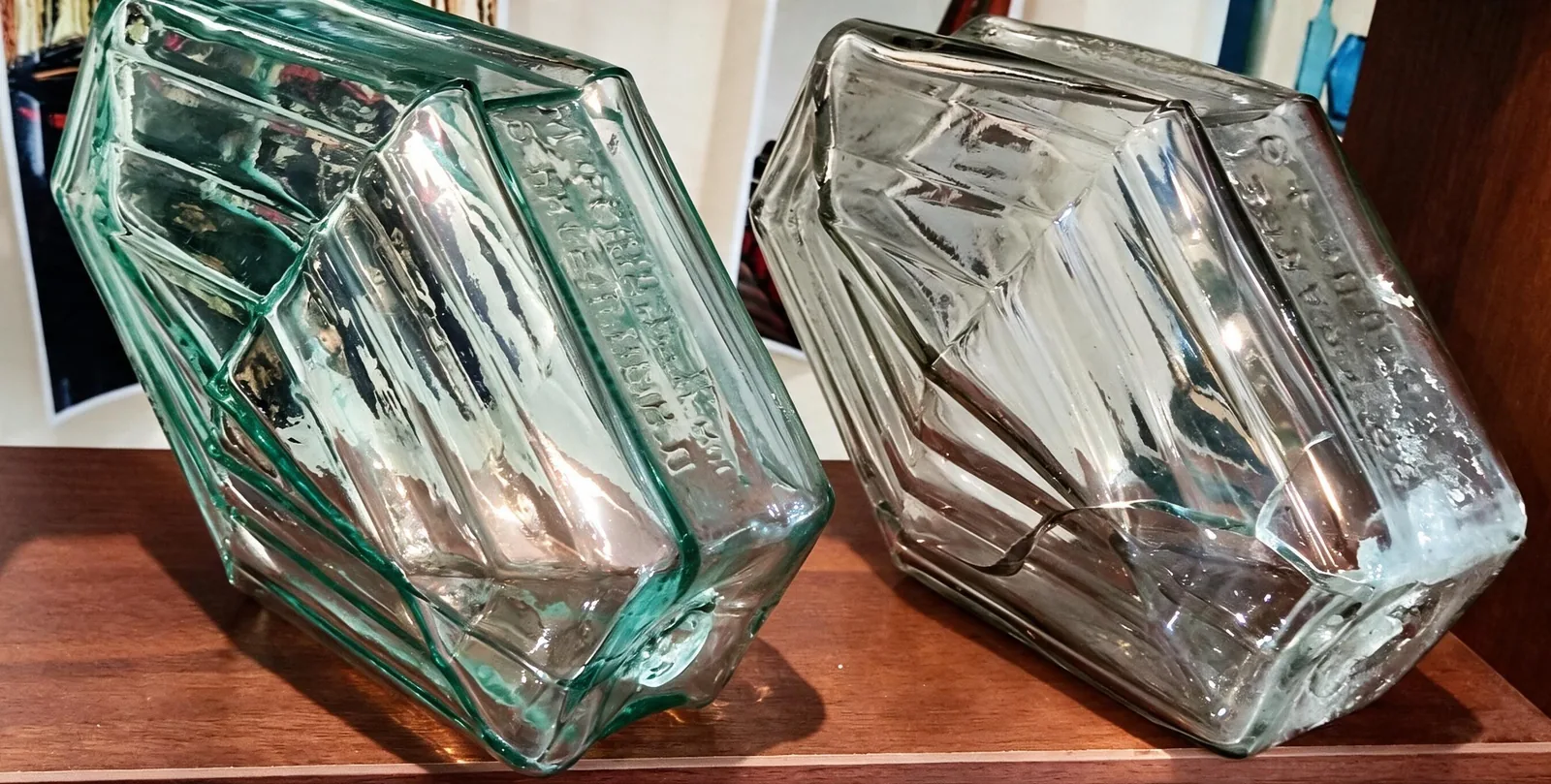 This is what the Falconier glass bricks look like, from which the windows are assembled.
Voices of the Past: Tsipa Molchadskaya, a Dye House, and a Japanese Shop
A real discovery for the restorers were the historic advertising signs hidden under layers of plaster and paint. The first one, on the entrance arch, advertised the services of a dye house: it could have been a dye shop or, most likely, a fabric dyeing workshop. Such signs were common practice for a revenue house at the beginning of the 20th century, where workshops and shops were located on the ground floors and in the arches.
The second sign, on the main facade in a niche, read: "Ts. M. Molchadskaya". From a 1928 directory, it is known that the entrepreneur with the interesting name Tsipa Moiseevna sold radio parts in this part of the building. Both signs were reinforced and preserved—the residents of the house asked to keep them as decoration.
According to the "All Moscow" directory for 1908 and advertisements, there was also a "Japan" shop here, offering lacquered boxes, trays, porcelain vases, plates, cups and teapots, paper fans and umbrellas, panels and paintings, screens, curtains, brushes, ink and paints for drawing, baskets, dolls and toys, silk handkerchiefs, kimonos, ivory items, and much more.
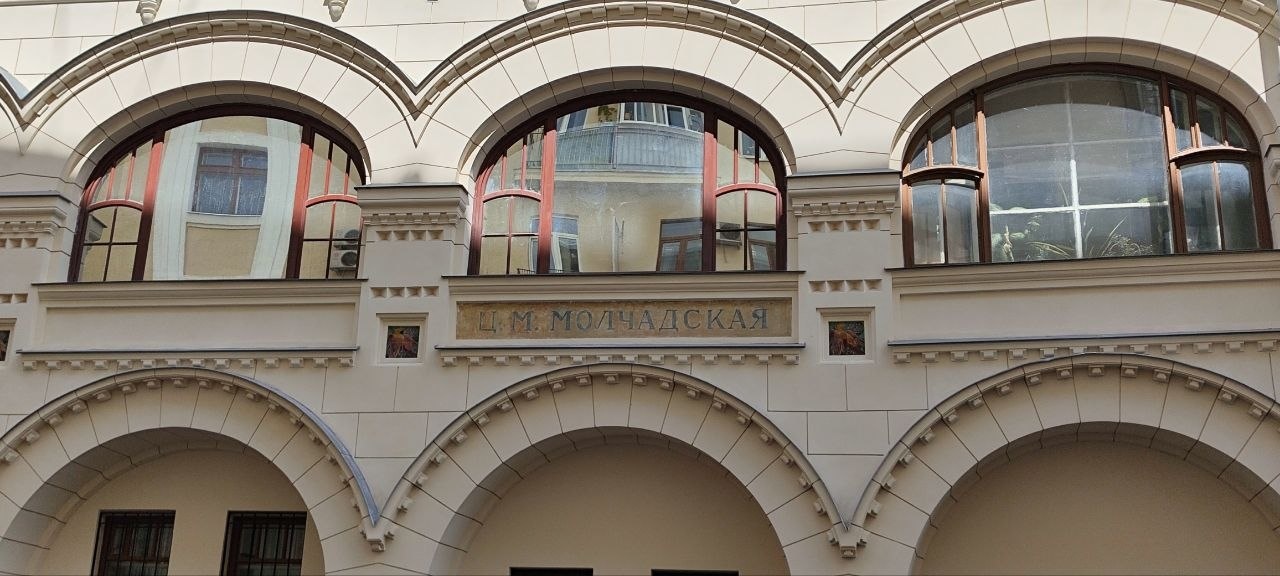 One of the mentioned signs.
A Cinematic Mecca: Khanzhonkov and Competitors
In the early 20th century, the Savvinskoye Podvorye was the cradle of Russian cinema. Alexander Khanzhonkov, one of the pioneers of the Russian film industry, rented studios and offices here.
In the courtyard of the Podvorye, he built a huge filming pavilion with a glass roof, where he managed to shoot such famous films as "Ermak, the Conqueror of Siberia", "Vanka the Steward", "The Mermaid", and "Boyarin Orsha". Actors from Stanislavski's theater and the singer Fyodor Chaliapin starred in his films. Vera Kholodnaya—the star of silent cinema—shone in the leading roles. In 1914, the film pavilion burned down, and Khanzhonkov moved out of the Podvorye.
In addition to the filming process, Khanzhonkov was engaged in film distribution and the sale of professional equipment. Curiously, competing firms were also located in the same revenue house: film companies "Napoleon", "Gaumont", "Film Ribbon", "Globe", and some others.
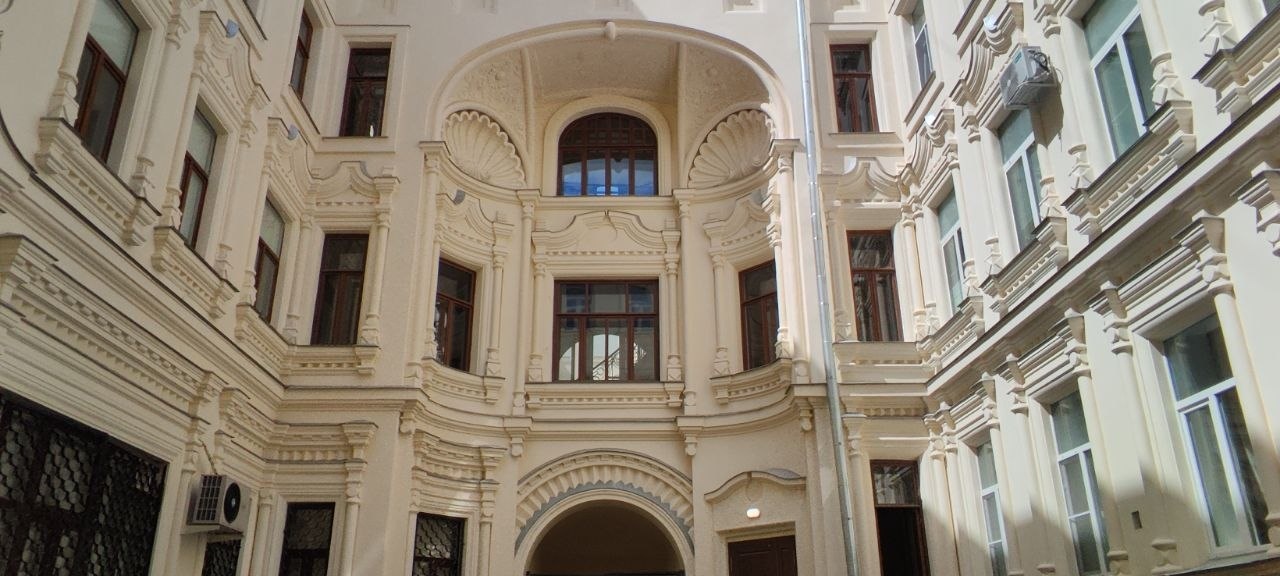 The revenue house in the inner part of the courtyard. A wonderful combination of Baroque and Art Nouveau
And... Artists in the Attic
In addition to filmmakers and merchants, artists took a liking to the Savvinskoye Podvorye. As early as 1905, a photographic pavilion was set up on the roof of the part of the house facing the street, behind the central kokoshnik from the courtyard. Later, the "Baklanov Painting Studio" was located there, with an area of 147 square meters: two light and one dark room, as well as a room with a partition. The studio brought the Podvorye a modest income—600 rubles, much less than the shops and apartments.
The Excavation Revealed...
During the restoration, about 150 specialists from Moscow and Kaluga worked on the Podvorye: masters of ceramics, plastering, marble, and artists. The restoration of the facades is the most noticeable part of the work. The walls of the house, clad in majolica tiles, were in an emergency state. The tiles had to be dismantled, restored, and put back in place, as well as recreating lost elements, carefully selecting materials and the right shades. On the roof, the spires, decorative metal tiles, and dormer windows were restored.
The grand entrances of the house with their curved staircases, wrought iron railings, stucco, and Mettlach tiles also passed through the hands of the restorers. In the entrances, stucco panels, coffered ceilings, and historic windows were cleaned and restored.
During the work, many small household artifacts were found in the ceilings and hidden niches: bottles and boxes of perfume, vinegar, shoe polish, wax, petroleum jelly, old receipts and letters... For some, this is just household garbage, but not for local historians. Many of the people who once inhabited these apartments are long gone, but here they are—these witnesses of time, making the history of the building truly warm and human. And all of this can be seen and touched.
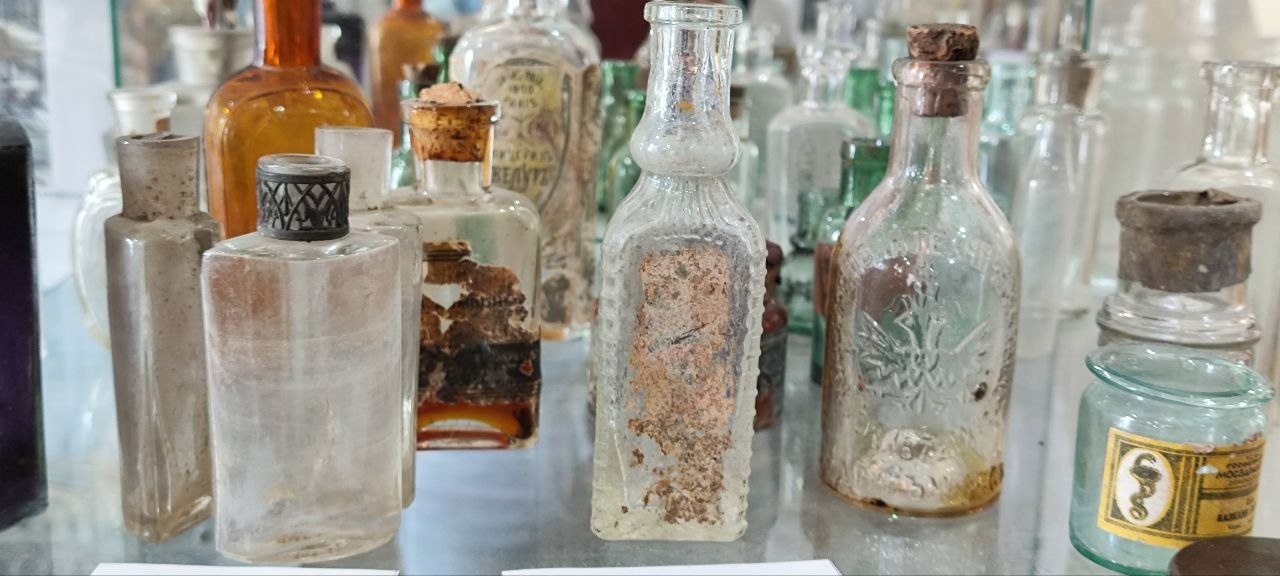 Restoration details.
© 2026 Ivetta Krasnogorskaya. All rights reserved.
Exclusive rights to this material (text and photographs) belong to the author. Any use of materials is permitted only with the written consent of the copyright holder. Full or partial copying, rewriting, distribution, and publication on the Internet without permission is prohibited.
When quoting, an active indexed link to the original source is required: mosivetta.ru/en/blog/savvinskoye-podvorye