Vladimir Tatlin: The Moscow Addresses of a Russian Leonardo
He ran away from home as a teenager, wandered the world for years, and invented legends about his own life so skilfully that even the people closest to him couldn't always tell truth from fiction. Vladimir Tatlin has every right to be called the great dreamer and adventurer of the Russian avant-garde. His tower was never built, his ornithopter never took off — and yet, without his ideas, the art of the twentieth century would have been much the poorer.
His journey began here, in Moscow. And here, 67 years later, it ended. This is the story of who Vladimir Tatlin was — and where to find his traces in our city.
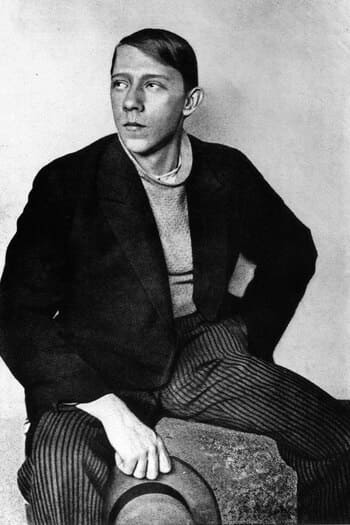 Vladimir Tatlin — a leading figure of the Russian avant-garde
"Neither the old nor the new, but the necessary"
This slogan hung in Tatlin's studio — and it seems to hold all of him in a single phrase. Vladimir Evgrafovich was born in Moscow on 28 December 1885. His father was an engineer and technologist from a hereditary noble family of Oryol; his mother was a poet. And yet the life he went on to lead was anything but aristocratic.
At 13, Tatlin left home and started living as an adult. He scraped by on odd jobs, signed on as a ship's boy, and travelled through Turkey, Bulgaria, Greece, Syria, Egypt and Palestine. This is where he picked up a habit that stayed with him for life — gathering knowledge and skills wherever he could, in any conditions, sometimes right on the edge of survival. In 1902 he enrolled at the Moscow School of Painting, Sculpture and Architecture, and was famously expelled within a year "for poor progress and disapproved-of behaviour". He would study again, in Odessa and Penza — and from then on, art would own him completely.
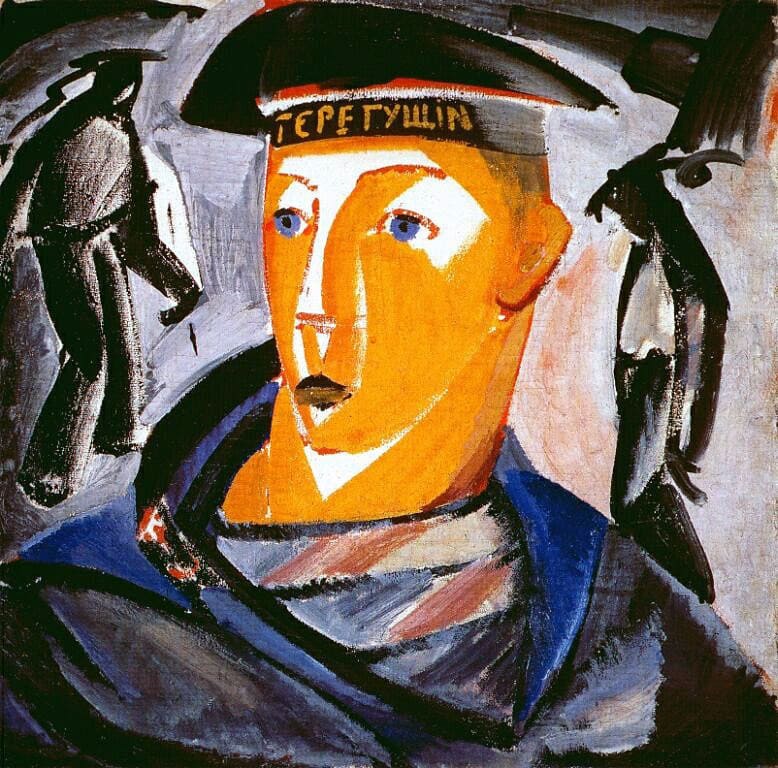 Sailor (Self-Portrait), 1911. One of his best-known early paintings
Ostozhenka 37: the studio where Moscow's entire art world gathered
In the summer of 1912, Tatlin opened his own studio at 37 Ostozhenka. A small flat with an austere workshop on the top floor became the place where the city's creative intelligentsia converged. The Vesnin brothers, Lyubov Popova, Nadezhda Udaltsova, Robert Falk and Valentina Khodasevich were regulars. Kazimir Malevich himself dropped in from time to time.
It was at Ostozhenka, so the story goes, that Tatlin began making his famous counter-reliefs. Scraps of tin, wood, wallpaper, wire — everything went into them. These compositions depicted nothing at all: they were objects of art in their own right. The artist even gave them a name of their own — "material selections". You can see one today at the New Tretyakov Gallery on Krymsky Val.
Malevich regarded his colleague's work with a certain irony. On one of Tatlin's drawings he once wrote: "Took cubism lessons from me." Defending his right to his own form of expression, Tatlin shot back: "I have pushed aside as unnecessary a whole series of 'isms' — the chronic disease of modern art."
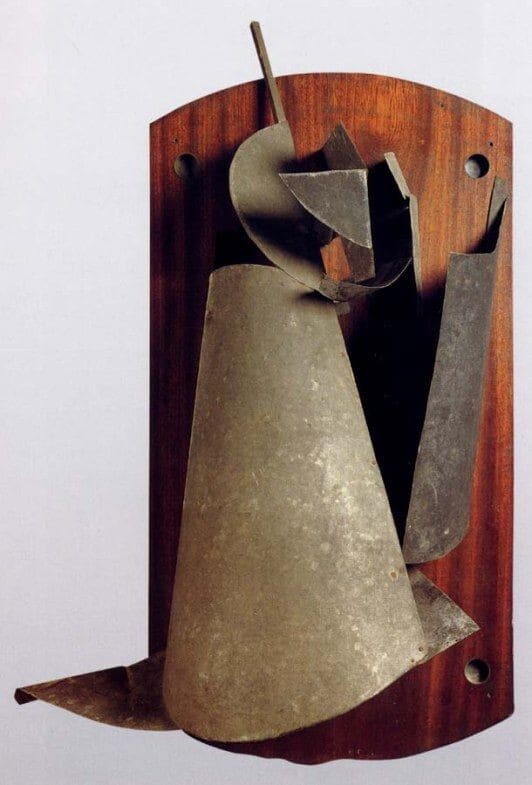 This counter-relief can be seen at the New Tretyakov Gallery on Krymsky Val
Another Moscow address
In 1915 Tatlin moved to 33 Staraya Basmannaya, into the Bashkirov income house — and once again a workshop appeared, this time in the attic. The regulars here were Vladimir Mayakovsky and Velimir Khlebnikov. Tatlin and Khlebnikov seemed to be on the same wavelength: one was inventing a new language, the other a new form.
It's hard not to picture it: a hundred-odd years ago, in this very attic, a tall, lean artist at work — narrow, long face and pale skin, straight hair falling over his forehead, a large shapeless nose and small eyes under colourless brows. Tatlin's movements are said to have looked clumsy, almost like a wrestler's, but behind that heavy exterior lay real agility and lightness. He loved his striped sailor's shirt (a habit from his seafaring youth), a jacket and wide trousers that wouldn't restrict movement. He spoke in an unhurried baritone. And when he picked up his homemade bandura and began to sing, it came out soulful and moving. Small wonder: that bandura had fed him rather well not long before, during a trip to Berlin for a handicrafts fair, where he posed as a blind musician. Though "posed" is hardly the word — it was more of a stage persona. It sometimes seems he spent his whole life performing rather than simply living.
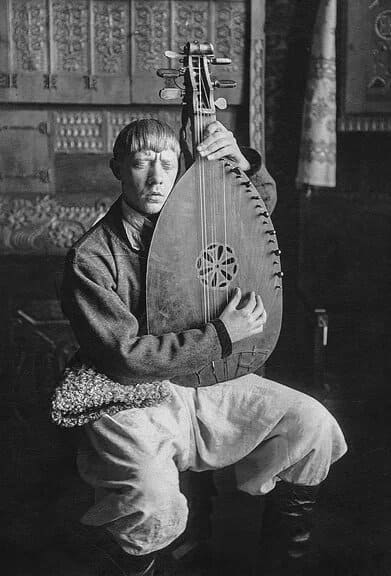 Tatlin in the role of the "blind" musician
Made of iron, glass and revolution
In 1919 Tatlin received a commission from Narkompros, the People's Commissariat of Education: to design a Monument to the Third International. This is the work that would make his name. Even today, in the popular imagination, Tatlin is firmly bound to that one tower — so much so that it eclipses nearly everything else he did.
He designed a structure 400 metres tall — nearly a hundred metres higher than the Eiffel Tower. Two steel spirals with glass volumes rotating inside them: a cube (one revolution per year), a pyramid (one per month), a cylinder (one per day) and a hemisphere (one per hour). Inside were to be the offices of the Comintern's legislative, executive and information bodies. And also — radio, telegraph, a cinema screen and projectors that would beam communist slogans... onto the clouds. We Russians did love our bold, barely feasible dreams — it was that kind of time.
The first model — five metres tall — was built of wood, plywood, twine and tin. In November 1920 it went on display in Petrograd; in December it was brought to Moscow, to the House of the Unions. But something went wrong: the project seemed too utopian and too expensive, and it was quietly allowed to sink from view. There is a story that the very first model was simply lost, and Tatlin later wrote to Mayakovsky in despair:
"They are using my model of the International at the House of the Unions as a samovar stand!"
And yet Tatlin's monument became something like an icon of the avant-garde. A model of it stands in the main hall of the Tretyakov Gallery on Krymsky Val. A more modern rendition — a bright red metal construction — can be seen in the atrium of the City of Capitals business centre in Moscow City. And a Tatlin tower crowns one of the elite residential complexes on Patriarch's Ponds. So... nothing was in vain?
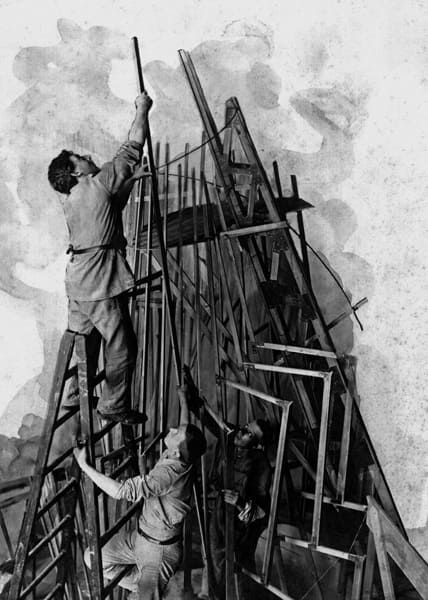 Vladimir Tatlin, Iosif Meerzon, Tevel Shapiro with the model of the Tower of the Third International, 1920
The coat you could wear forever
Tatlin was never "just an artist". He bubbled with ideas and kept trying his hand in new fields. In the early 1920s, it seems, he had identified the Soviet citizen's main problem: there was no clothing to speak of, and what there was was impractical and wore out quickly. And so he came up with the "Normal".
The name says it all — a standard, a norm, a model. Tatlin designed a universal coat-jacket in rubberised fabric, meant to replace several garments at once. The secret lay in the detachable linings: a flannel one for autumn, a fur one for winter. Worn through an elbow? No problem — you replaced a single part instead of throwing the whole thing away. The cut was as simple as it could be, with nothing superfluous. The pockets were placed exactly where the hands fall naturally. The shape widened at the shoulders and narrowed towards the hem to hold in the warmth.
The "Normal" was developed in Petrograd, at GINKhUK — the State Institute of Artistic Culture, where Tatlin headed the Department of Material Culture. But his ideas found an echo in our city too: photographs of the models and the patterns were published in the Moscow magazine Novy Byt ("New Everyday Life").
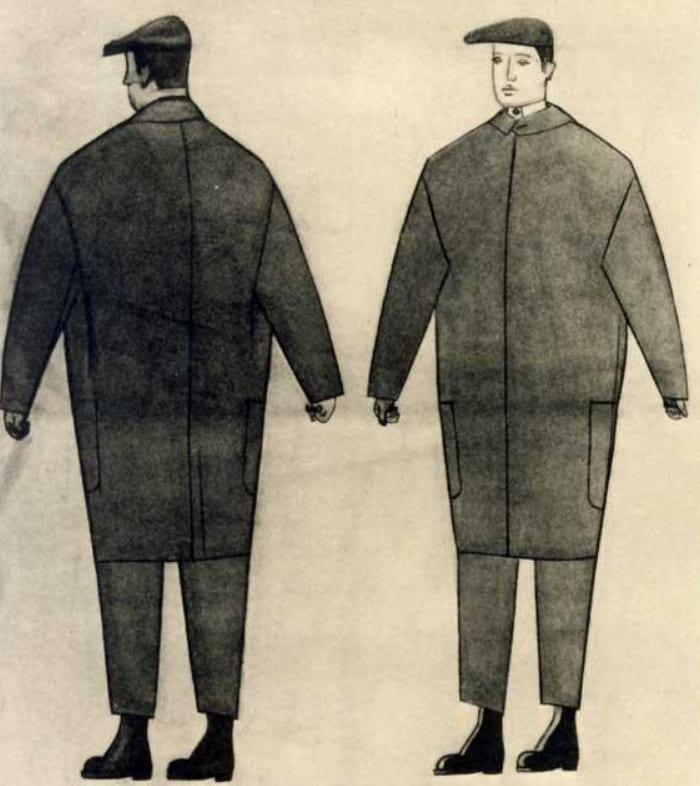 The "Normal" coat, back and front view. A magazine clipping
The "father" of minimalism and functionality?
Remarkably, he worked on tableware and furniture too. Teapot, cup, saucer, milk jug, sugar bowl — in 1923 Tatlin designed a minimalist porcelain service. Everything plain, monochrome, without ornament. It was a deliberate rejection of decoration in favour of form dictated by material and function. The service, too, was designed at GINKhUK.
Later, under his attentive guidance, his student Alexei Sotnikov — during a factory internship at the Dulyovo porcelain plant — created baby drinking cups in the shape of a woman's breast, to make it easier for a child to adjust to drinking independently. The first batch was a hundred cups; not one has survived to our day.
Around 1927, when Tatlin was teaching at VKhUTEMAS — the Higher Art and Technical Studios — another of his students, Nikolai Rogozhin, built, under the master's supervision, a model of a cantilever chair.
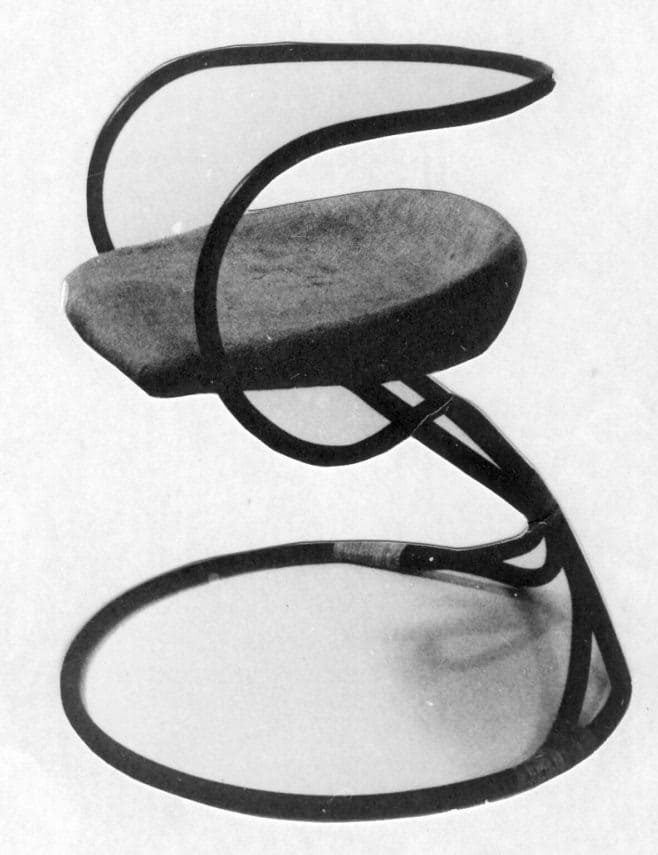 The perfect chair, in Tatlin's view
An ordinary chair is four legs, a seat and a backrest. Tatlin's was a single S-shaped structure of curved maple blocks, bent on the principle of Viennese furniture. The lower curve forms the legs and supports, the upper one the backrest and armrests, with the seat in the middle. Why wood and not the fashionable steel tubing of the day? Tatlin's answer was a reminder: we have plenty of forests; use what is at hand and make things no worse than the West's. But this project, too, went nowhere.
The main work of his life
Between 1929 and 1932 Tatlin worked on the strangest creation of all — an engineless flying machine that he jokingly named the "Letatlin" (a pun on letat, "to fly", and his own name). His workshop now occupied a corner tower of the Novodevichy Convent. The sacred buildings that hadn't been demolished in the Soviet Union were put to the service of society — many of them as creative studios. Above the entrance hung a sign: "Research Laboratory for the Culture of Materials".
Together with three assistants — Alexei Sotnikov, Georgy Pavilonov and Alexey Shchipitsyn — Tatlin built three copies of the machine. One of them, covered in white silk, was displayed in 1932 at the Pushkin Museum of Fine Arts, right above the statue of David.
The wingspan was nearly 10 metres, the weight 32 kilograms. A framework of ash and lime, covered in silk and leather, with ribs of willow and whalebone. The idea was that a person would fly this ornithopter by flapping its wings — like a bird.
Sounds like madness? Perhaps. But Tatlin took it seriously: he studied the anatomy of birds and even dissected them to work out the mechanics of the wing. Some years earlier, living in Kyiv, he had kept a stork in the house, feeding it frogs. The bird drove the neighbours to distraction, and they called the police more than once. The landlady, meanwhile, took Tatlin's eccentricities quite in her stride.
The tests, however, failed: the wind was too weak, and the machine never left the ground. But Tatlin wasn't greatly discouraged — he considered the apparatus the main work of his life. What mattered was the idea, the impulse; the rest was mere engineering. Once, explaining his vision at the Writers' Club, he said:
"Calculations? Have you ever asked a crow what calculations her wings were built on?"
Today the only surviving Letatlin can be seen at the Central Air Force Museum in Monino. After restoration, one of its wings was left uncovered, so that the inner structure stays visible.
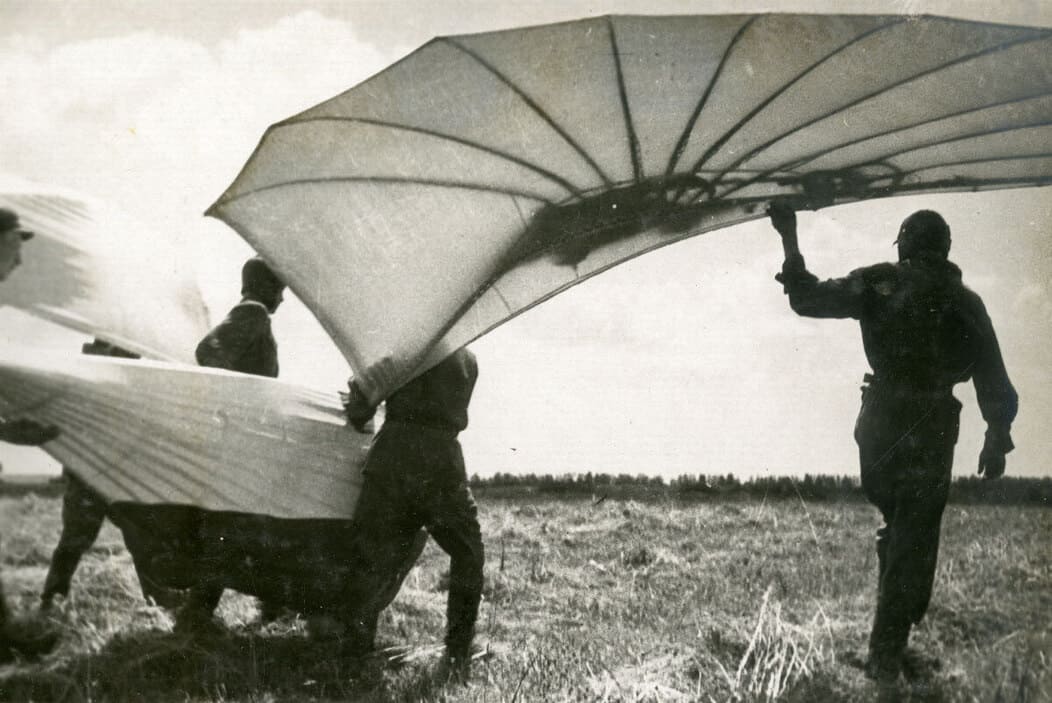 Testing the Letatlin
The road into the shadows
The year 1933 became a symbolic dividing line. At the anniversary exhibition "Artists of the RSFSR Over 15 Years", Tatlin was given nothing more than a cramped corner — they were already trying to push him out of history. And the critic Abram Efros delivered a merciless verdict:
"We have no business with Tatlin. Tatlin is no artist at all."
The state had finally settled on socialist realism, and the man who had dreamed of redrawing the universe found himself surplus to requirements in the new reality. The theatre was what remained to him: within the conventions of the stage, his rebellious genius could still find refuge.
The stage became Tatlin's natural element in the 1930s and 40s. Over his lifetime he designed more than eighty productions, working with the grand masters of Moscow directing — but always within the boundaries drawn by ideology. And in the early 1950s came an ending that felt almost like mockery: he led a team of artists producing visual aids for the university. The same Tatlin whose projects had once seemed like daring prophecies was now drawing charts for students.
They say that near the end he kept asking: "Who will finish my bird? Who will build the Tower? Who will love my paintings?"
He died on 31 May 1953. By his will, his body was cremated and his ashes buried at Novodevichy Cemetery. Only a handful of people came to say goodbye.
And yet he is still somewhere near — in every bend of his lines, in every audacity of his designs...
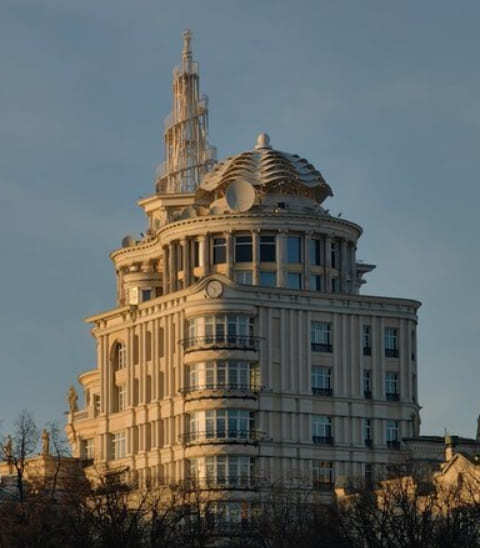 The Tatlin tower crowning the "Patriarch" residential complex
© 2026 Ivetta Krasnogorskaya. All rights reserved.
Exclusive rights to this material (text and photographs) belong to the author. Any use of materials is permitted only with the written consent of the copyright holder. Full or partial copying, rewriting, distribution, and publication on the Internet without permission is prohibited.
When quoting, an active indexed link to the original source is required: mosivetta.ru/en/blog/tatlin-moscow-addresses