Millionaires of Vorontsovo Pole: The Story of the Wogau and Mark Dynasties
The Street That Is Not on the Map
In the late 19th century, the Moscow street Vorontsovo Pole was half-jokingly called "Wogaustrasse". And no wonder: everything here belonged to the family of German Wogau-Marks—one of the richest dynasties in the Russian Empire. They owned mansions, factories, shops, warehouses... The Wogau & Co concern ranked sixth among all the entrepreneurial empires of pre-revolutionary Russia.
On this street and in the neighboring lanes, they had several houses. One of them—in Nikolorobinsky Lane—is open to visitors today. It houses the Russian Museum of Medicine, which, by the way, has plenty of fascinating exhibits, such as the huge field pharmacy of Emperor Nicholas II.
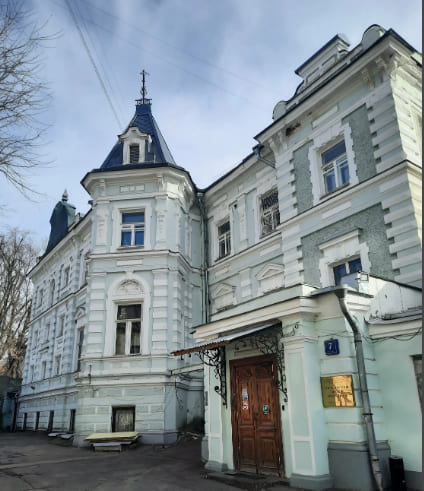 The main house of the estate
The mansion itself does not catch the eye too much: it is hidden deep in the courtyard and slightly neglected—no scientific restoration has ever been carried out during its existence. But the interiors are worth a visit.
The facade features a cartouche with the letters "SM". They remind us that the mistress of this house was Sofia Karlovna Mark. She and her husband Moritz, being first cousins, came from the Wogau clan. Therefore, these two surnames—Wogau and Mark—often go hand in hand.
But let's take everything in order.
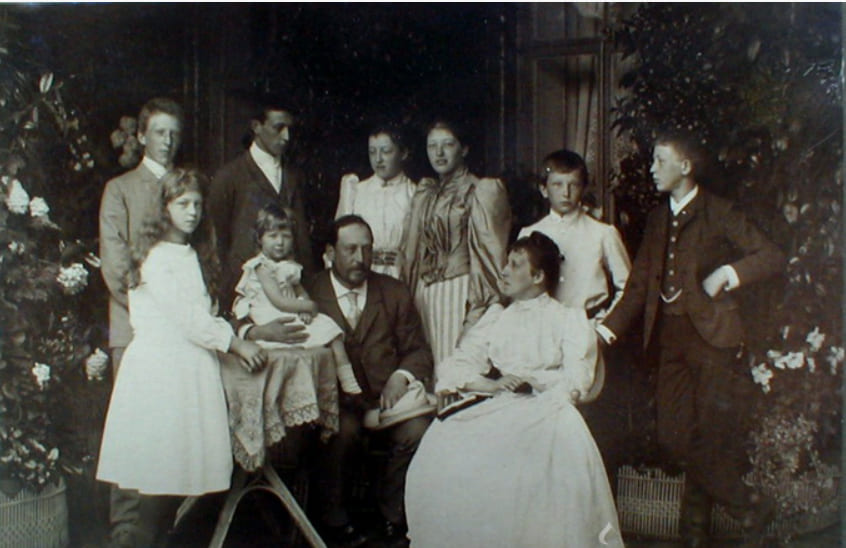 Moritz, Sofia and their children at the end of the 19th century
How a Courier Became a Magnate
It all began in 1828. A young man named Philipp Maximilian von Wogau arrived in Moscow from Frankfurt am Main. Without money, without connections—just an ordinary émigré. He got a job as a courier at the firm of another German. But over time, he rose to manager, married a representative of the Rabenek family (famous textile magnates), and in 1840 opened his own tea trading office.
Tea became the starting capital that made it possible to build three tea-packing factories—in Moscow, Ufa, and Odessa. One of the Wogau shops could be seen on Arbat, in the building of the famous "Praga" restaurant. And if you find yourself in Ufa, don't be too lazy to look for the old building of the Wogau tea-packing factory: now it is an art space, and the facades feature thematic mosaics dedicated to the dynasty.
When money began to flow like a river, the family began investing it in industry. In their hands were copper-rolling and cement factories, mines in Donbas (including the famous "Karl Mine"—the first vertical shaft in the region), Beloretsk enterprises in the Urals, where ore was processed.
Later, the Wogau-Marks would become among the first in Moscow to start selling German automobiles. Sofia's husband Moritz had a personal car—at that time it was a miracle of technology. When they went out in their "chariot", everyone around shied away, and they themselves—in long coats and glasses—were taken for Martians, as the couple's granddaughter Maria Dobrovaina later recalled.
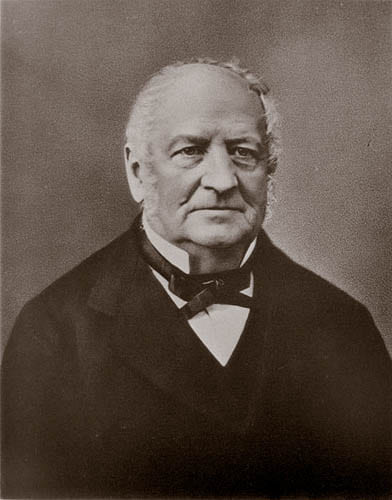 Philipp Maximilian von Wogau—founder of the dynasty
Interiors That Survived Time
In 1870, the Marks bought the estate from the family of the playwright Alexander Ostrovsky. The house, built by his father Nikolai, seemed insufficiently comfortable to them. They hired the architect Viktor Kossov, known, for example, for the Lutheran cathedral in Starosadsky Lane. In 1886, the mansion was ready and joyfully opened its doors to the owners and their children.
The Entrance Hall
The first thing you see when entering the mansion is the marble staircase and a beautifully preserved gas floor lamp (the shades, however, have long since been replaced). The floor in the entrance hall is original Mettlach tiles, which have been lying here for almost a century and a half! Behind the glass with plant ornament, there was once the greenhouse of Sofia Karlovna, who adored growing flowers and fruits. On the old plans of the estate, you can see both the garden and the vegetable garden with greenhouses.
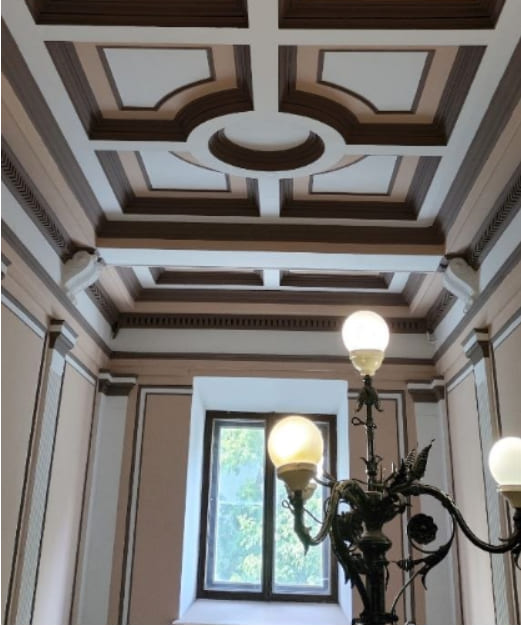 A fragment of the ceiling and the gas floor lamp
The Small Drawing Room
A grand piano once stood here. The hospitable Mark family hosted the Moscow beau monde: musicians, theater figures, especially artists of the Maly Theater, and were friends with the Ryabushinskys. A marble fireplace has been preserved in the drawing room—to be fair, the most modest of all in the house.
But there is another amazing detail here: sliding doors. During the Soviet period, they were simply walled up in the wall. Perhaps that is why the original doors of the 1880s still slide easily, without effort or creaking.
The "Trompe-l'œil" Room
In the room closest to the garden, the oak parquet is perfectly preserved. However, the ceiling here turns out to be a plaster imitation of wood—the cracks give away the illusion! Probably, it was a smoking room: wood absorbs odors, so the owners decided to use a substitute.
The fireplace in this room is a real masterpiece made of German tiles: here are scenes of knightly duels and images of satyrs. Moritz Mark loved to play up the German theme in the interior. After all, he was not just an entrepreneur, but also the honorary German vice-consul in Moscow.
The Oak Dining Room
The most luxurious room of the mansion. A chic original ceiling, parquet, a huge fireplace with hand-painted medallions, and beautiful built-in wooden furniture. But almost no personal belongings remain: the family took all documents and valuables out of the country.
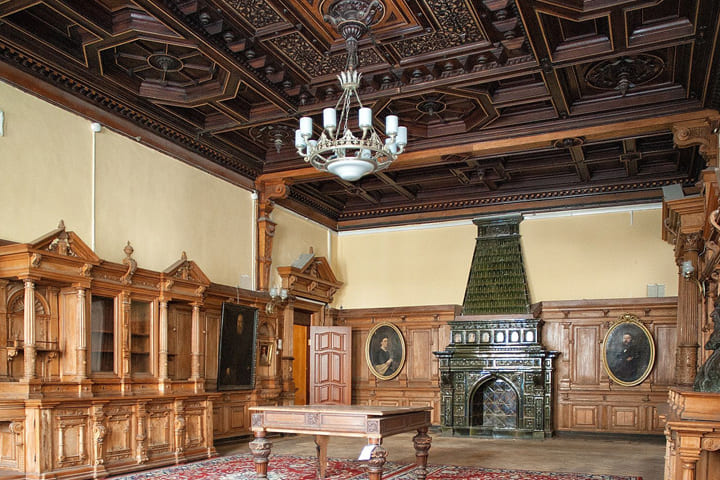 The oak dining room—the most beautiful room in the house. Photo from the Museum of Medicine website
After nationalization, the mansion became part of the Narkomzdrav system. First, there was an apothecary warehouse, then—the Institute of Nutrition, where Professor Pevzner, the creator of the famous dietary tables, worked. Today, it is the Museum of Medicine, which I wholeheartedly recommend visiting.
But What About the Family?
Sofia and Moritz Mark had many children. One of the sons, Walter Mark, left memoirs from which we know a lot about their lives. During World War I, he fell under discriminatory laws against ethnic Germans: he was arrested and kept in prison for several days, awaiting deportation. But he was eventually released—the family still had levers of influence. However, as Walter wrote, he suddenly felt like a stranger in the country where he had spent his whole life.
After the revolution, the entire Mark family emigrated. All but one.
Hugo Mark was not only an entrepreneur but also a famous philanthropist who invested in Russian science. In 1918, he suddenly died of a broken heart, leaving behind two sons.
His eldest son Maxim received an engineering education at the Bauman School, became a professor in the field of communications, and even joined the Bolshevik party. It seemed he fit well into the new reality, but it was not to be. In the terrible year of 1937, he fell victim to political repressions. His last address was an Arbat communal apartment.
Hugo's younger son—Konrad—was luckier. He left with his mother for Sweden, graduated from university, became a philosopher, and lived a long and, one hopes, quite happy life. Today, the descendants of the dynasty are scattered all over the world.
© 2026 Ivetta Krasnogorskaya. All rights reserved.
Exclusive rights to this material (text and photographs) belong to the author. Any use of materials is permitted only with the written consent of the copyright holder. Full or partial copying, rewriting, distribution, and publication on the Internet without permission is prohibited.
When quoting, an active indexed link to the original source is required: mosivetta.ru/en/blog/vogau-mark-millionaires